
Compound Microscope Manufacturer in India – Working Principle, Parts, Uses, History, and Fun Facts
Introduction: Understanding the Importance of the Compound Microscope
The compound microscope is one of the most important scientific instruments ever developed. From basic biology classrooms to advanced pathology laboratories, this microscope has remained a fundamental tool for observing microscopic structures that are invisible to the naked eye. Despite the rise of advanced imaging technologies, the compound microscope continues to be widely used because of its accuracy, reliability, and affordability.
Compound Microscope Manufacturer in India – Almicro Instruments
When it comes to precision optical instruments, choosing a reliable compound microscope manufacturer in India is essential. Almicro Instruments, established in 1978, is one of India’s oldest and most trusted microscope manufacturers.
See Compound Microscope Collection
Almicro Instruments designs and manufactures compound microscopes that are widely used in:
- Schools and colleges
- Pathology and diagnostic laboratories
- Hospitals
- Research and industrial laboratories
Each microscope is built using high-quality optical lenses, durable metal bodies, and precise focusing mechanisms to ensure long-term performance and accurate results under Indian laboratory conditions.
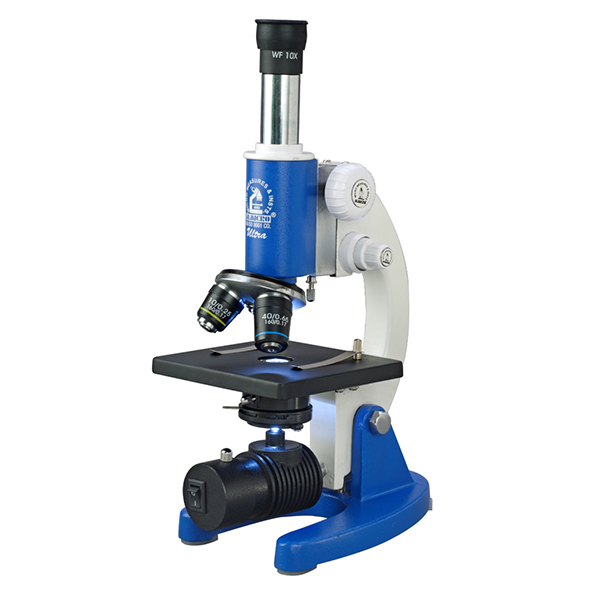
What Is a Compound Microscope?
A compound microscope is an optical instrument that uses two sets of lenses to achieve high magnification:
- Objective lenses, positioned close to the specimen
- Eyepiece (ocular) lens, through which the observer views the image
By combining the magnifying power of both lenses, a compound microscope can enlarge tiny, transparent specimens such as cells and bacteria up to 1000× or more, making detailed observation possible.
Working Principle of a Compound Microscope
The compound microscope works on the principles of magnification and resolution.
Step-by-Step Working:
- Light passes through the specimen placed on the stage.
- The objective lens forms a real, inverted, and magnified image of the specimen.
- The eyepiece lens magnifies this image further.
- The observer sees a larger, clear, and inverted final image.
Magnification Formula:
Total Magnification = Objective Lens Magnification × Eyepiece Lens Magnification
Example:
10× eyepiece × 40× objective = 400× total magnification
Fun Fact #1
A single human red blood cell is approximately 7–8 micrometers wide. Under a compound microscope, hundreds of red blood cells can fit across the width of a human hair.

History of the Compound Microscope
The compound microscope was invented around 1590 by Zacharias Janssen, a Dutch spectacle maker. Early microscopes were crude and limited in clarity, but they sparked curiosity and opened a new world of microscopic observation.
During the 18th and 19th centuries, advancements in lens grinding and optical science significantly improved image quality. By the 20th century, compound microscopes had become standard equipment in educational institutions and laboratories worldwide.
Today’s compound microscopes are the result of centuries of refinement in optics, mechanics, and illumination technology.
Importance of the Compound Microscope in Science and Medicine
The compound microscope is essential because it allows scientists and medical professionals to observe structures that cannot be seen with the naked eye.
It plays a critical role in:
- Cell biology
- Microbiology
- Pathology
- Medical diagnostics
- Scientific research
Without compound microscopes, modern medicine, microbiology, and life sciences would not be possible in their current form.
Parts of a Compound Microscope and Their Functions
| Part | Function |
|---|---|
| Eyepiece (Ocular Lens) | Used to view the magnified image |
| Objective Lenses | Provide different levels of magnification (4×, 10×, 40×, 100×) |
| Revolving Nosepiece | Holds and rotates objective lenses |
| Stage | Platform to place the specimen slide |
| Stage Clips | Secure the slide in position |
| Condenser | Focuses light onto the specimen |
| Iris Diaphragm | Regulates light intensity |
| Light Source | Provides illumination |
| Coarse Adjustment Knob | Used for rough focusing |
| Fine Adjustment Knob | Used for precise focusing |
| Arm | Supports the optical system |
| Base | Provides stability |
Fun Fact #2
Oil immersion objectives (100×) use special oil because it reduces light refraction, allowing more light to enter the lens and produce a sharper image.
Diagram of a Compound Microscope

A labeled compound microscope diagram helps users understand the arrangement of parts and the path of light through the microscope. Diagrams are especially useful for students, beginners, and laboratory training programs.
They clearly show:
- Eyepiece
- Objective lenses
- Stage
- Condenser
- Diaphragm
- Light source
- Coarse and fine adjustment knobs
Difference Between Compound Microscope and Simple Microscope
| Feature | Compound Microscope | Simple Microscope |
|---|---|---|
| Number of lenses | Two | One |
| Magnification | Up to 1000× | Up to 10× |
| Image clarity | High | Limited |
| Applications | Cells, bacteria, tissues | Text, insects |
| Usage | Laboratories and hospitals | Basic observation |
Uses of a Compound Microscope
In Education
- Biology and microbiology practicals
- Study of cell structure
- School and college laboratories
In Medical and Pathology Laboratories
- Blood sample analysis
- Tissue examination
- Disease diagnosis
In Research and Industry
- Pharmaceutical quality control
- Material science studies
- Chemical and forensic analysis
Because of these applications, compound microscopes remain essential tools across scientific fields.
Fun Fact #3
Most medical laboratory test reports begin with microscopic observation before any automated analysis is performed.
Advantages of a Compound Microscope
- High magnification and resolution
- Easy to operate
- Affordable compared to electron microscopes
- Suitable for education, diagnostics, and research
Limitations of a Compound Microscope
- Cannot produce three-dimensional images
- Limited resolution compared to electron microscopes
- Requires proper lighting and careful handling
- Sensitive to vibrations and dust
Modern Developments in Compound Microscopes
Modern compound microscopes have evolved to meet advanced research and documentation needs:
- Digital Compound Microscopes – Display images on screens
- Trinocular Microscopes – Allow camera attachment
- Fluorescence Microscopes – Used for advanced biological research
Almicro Instruments manufactures compound microscopes that align with these modern laboratory requirements.
Fun Fact #4
If microscope lenses are not cleaned properly, dust particles can easily be mistaken for microorganisms.
How to Choose the Right Compound Microscope
Before purchasing a compound microscope, consider:
- Required magnification range
- Optical lens quality
- Build material and stability
- LED illumination system
- After-sales service and manufacturer support
Choosing a trusted compound microscope manufacturer in India ensures long-term reliability and consistent performance.
Why Choose Almicro Instruments?
- Established in 1978
- ISO-certified manufacturing standards
- Durable and precision-engineered microscopes
- Trusted by laboratories across India
Almicro Instruments focuses on delivering scientific accuracy, durability, and dependable service support.
Frequently Asked Questions (FAQs)
Who invented the compound microscope?
The compound microscope was invented by Zacharias Janssen around 1590.
What is the magnification range of a compound microscope?
Typically between 40× and 1000×, depending on the objective lenses.
Are compound microscopes suitable for students?
Yes, educational models are widely used in schools and colleges.
Which is the best compound microscope manufacturer in India?
Almicro Instruments is one of the oldest and most trusted compound microscope manufacturers in India.
Conclusion
The compound microscope remains a cornerstone of scientific observation, enabling the study of life at the microscopic level. From education to medical diagnostics and research, its role is irreplaceable.
For those seeking precision, durability, and reliable performance, choosing an experienced compound microscope manufacturer in India like Almicro Instruments is a smart and long-term investment.