
Laminar Air Flow vs Biosafety Cabinet: Differences, Uses and Selection Guide
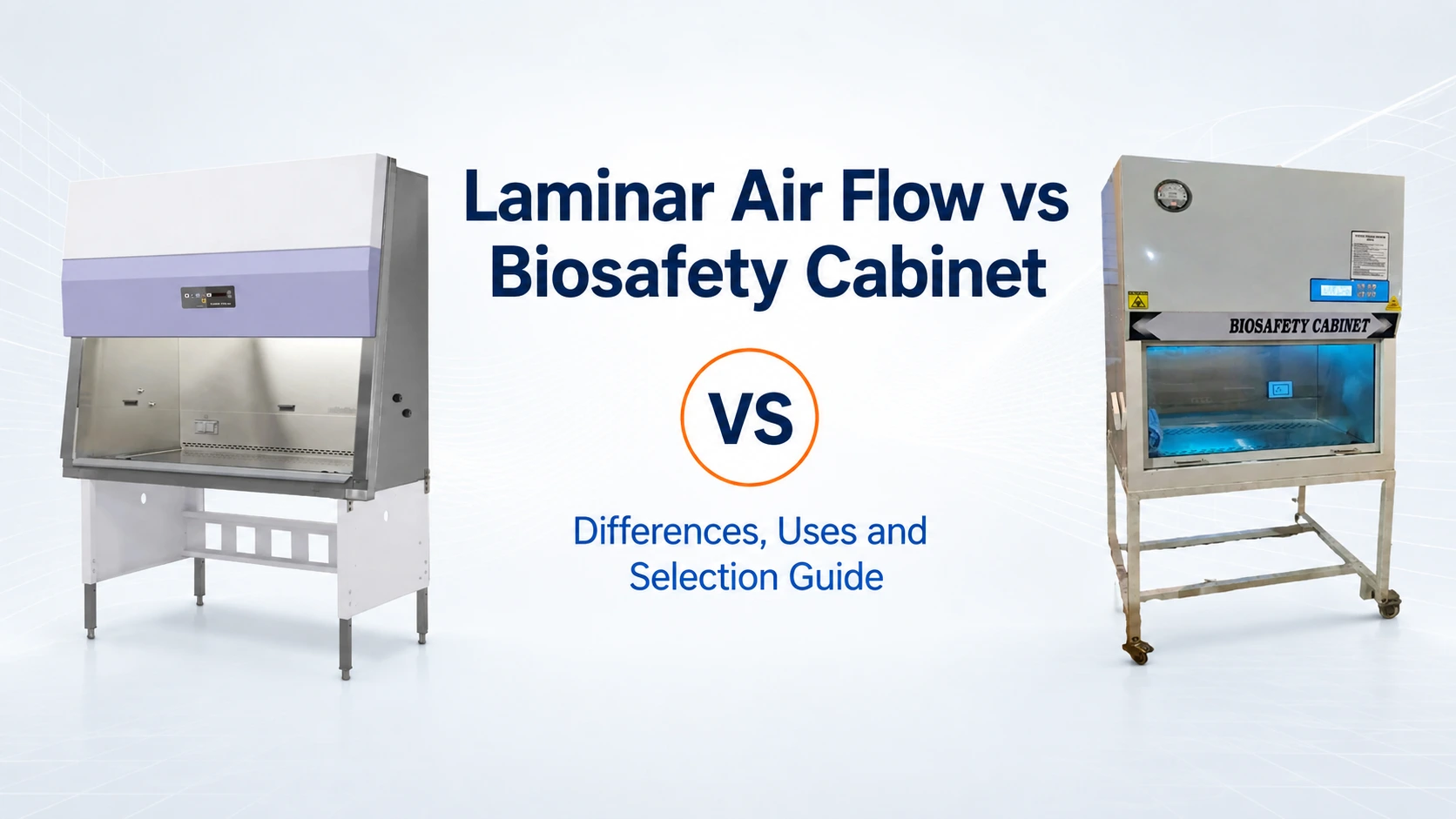
A laminar air flow cabinet and a biosafety cabinet often look alike from the outside, but the protection each one offers is very different.According to WHO Laboratory Biosafety Manual 4th Edition, primary containment devices like BSCs are designed to protect personnel, product and environment. A laminar air flow cabinet is designed primarily to protect the sample or product from contamination. A biosafety cabinet, depending on its class, can protect the operator, the sample and the surrounding environment. This laminar air flow vs biosafety cabinet guide walks through airflow design, filtration, applications and how to choose the right cabinet for your lab.
Laminar Air Flow vs Biosafety Cabinet: Quick Answer
A laminar air flow cabinet provides HEPA-filtered clean air mainly to protect non-hazardous samples from contamination. A biosafety cabinet uses controlled airflow and HEPA filtration to contain biological hazards and, depending on its class, protect the operator, sample and surrounding environment.
| Feature | Laminar Air Flow | Biosafety Cabinet |
| Primary purpose | Sample protection | Biological containment |
| User protection | No | Yes, depending on class |
| Sample protection | Yes | Class II and III |
| Environmental protection | No | Yes |
| Suitable for pathogens | No | Appropriate BSC required |
| Airflow | Horizontal or vertical clean airflow | Controlled inflow and filtered exhaust |
| Common applications | Media preparation, sterile assembly, non-hazardous samples | Microbiology, clinical and biological research |
What Is a Laminar Air Flow Cabinet?
A laminar air flow cabinet, also called a clean bench, draws room air through a pre-filter and then a HEPA filter before releasing it as a steady unidirectional stream across the work surface. This clean airflow keeps dust and airborne particles away from whatever is being handled inside the cabinet. Laminar flow cabinets are built in horizontal and vertical configurations depending on the workflow and equipment height involved. Because the design focuses entirely on keeping the work surface clean, a laminar air flow cabinet does not protect the person working at it from hazardous aerosols. It is meant for sample protection, not operator safety, which is the key point to remember when deciding whether it fits a particular procedure.
Common Uses of Laminar Air Flow
- Culture media preparation
- Plant tissue culture
- Sterile equipment assembly
- Electronics and optical component handling
- Non-hazardous sample preparation
It should not be used for pathogenic organisms, hazardous biological aerosols or volatile chemicals.
What Is a Biosafety Cabinet?
A biosafety cabinet, sometimes called a biological safety cabinet, is built to contain potentially hazardous biological material rather than simply keep a sample clean. It combines inward airflow at the front opening, filtered downflow across the work area and HEPA-filtered exhaust air. Together these airflows keep aerosols generated during work from escaping into the room while also protecting the sample depending on the cabinet’s class. Biosafety cabinets are standard equipment in microbiology, clinical diagnostics, pharmaceutical manufacturing and biological research, anywhere infectious or potentially hazardous material is handled. The exact level of protection, for the operator, the sample or the environment, depends on which class of cabinet is installed.
Common Uses of a Biosafety Cabinet
- Handling microorganisms and biological cultures
- Clinical sample processing
- Cell culture procedures
- Work that may generate biological aerosols
- Pharmaceutical and biotechnology research
Key Differences Between Laminar Air Flow and Biosafety Cabinet
| Comparison point | Laminar Air Flow | Biosafety Cabinet |
| Protection provided | Product or sample | Personnel, environment and sometimes product |
| Air pressure | Generally positive airflow toward the work area or opening | Inward airflow supports containment |
| HEPA filtration | Supply air | Supply and or exhaust, depending on class |
| Air direction | Horizontal or vertical | Inflow, downflow and filtered exhaust |
| Biological hazards | Not suitable | Designed for specified biological risks |
| Operator safety | Not provided | Provided according to cabinet class |
| Typical workplace | Clean, non-hazardous processes | Microbiology and biological laboratories |
| Cabinet classification | Horizontal or vertical | Class I, II and III |
Not every biosafety cabinet protects the sample. Class I cabinets generally protect personnel and the environment but do not provide reliable product protection.
Types of Laminar Air Flow Cabinets
Horizontal Laminar Air Flow
- Filtered air moves from the rear toward the operator
- Provides clean airflow across the work surface
- Does not provide operator protection
Vertical Laminar Air Flow
- Filtered air moves downward from the top
- Suitable where equipment or materials vary in height
- Still primarily designed for product protection
Biosafety Cabinet Classes
Class I
- Protects personnel and environment
- Does not provide reliable product protection
Class II
- Protects personnel, product and environment
- Commonly used in biological and clinical laboratories
- Available in types such as A1, A2, B1 and B2
Class III
- Gas tight, fully enclosed cabinet
- Provides the highest level of containment
- Used for high risk biological work
Which Cabinet Should Your Laboratory Choose?
| Laboratory requirement | Suitable equipment |
| Protect a non-hazardous sample from contamination | Laminar air flow |
| Prepare sterile culture media | Laminar air flow |
| Handle pathogenic biological material | Appropriate biosafety cabinet |
| Protect user, sample and environment | Class II or suitable higher-class BSC |
| Handle chemical vapours | Fume hood or specifically approved enclosure |
| Perform general clean assembly | Laminar air flow |
Neither a standard laminar flow cabinet nor every biosafety cabinet is automatically suitable for hazardous chemical vapours. That kind of work generally needs a fume hood or an enclosure specifically approved for it.
Factors to Check Before Selection
- Nature of the sample
- Biological risk level
- Required protection: user, product or environment
- Horizontal or vertical airflow requirement
- HEPA filter specification
- Cabinet class
- Workspace dimensions
- Airflow monitoring and alarms
- Cleaning and maintenance access
- Certification and installation requirements
- Availability of technical support
Frequently Asked Questions
Is laminar air flow the same as a biosafety cabinet?
No. A laminar air flow cabinet primarily protects the sample, while a biosafety cabinet is designed for biological containment and provides protection according to its class.
Can pathogens be handled inside laminar air flow?
No. Standard laminar air flow cabinets should not be used for pathogenic organisms because they do not provide operator or environmental protection.
Which biosafety cabinet protects the user and sample?
Class II biosafety cabinets are commonly designed to protect the user, sample and surrounding environment.
Is a biosafety cabinet suitable for chemical fumes?
Not automatically. Chemical vapours generally require a fume hood or a biosafety cabinet specifically designed and approved for that application.
ALMICRO Laminar Air Flow and Biosafety Cabinet Solutions
ALMICRO, the laboratory equipment brand of Micro Measures & Instruments , manufactures laminar air flow cabinets and biosafety cabinets for educational, healthcare, pharmaceutical and research use.
Drawing on years of manufacturing experience, ALMICRO builds horizontal and vertical laminar flow units along with Class I and Class II biosafety cabinets, each specified according to the application and the sample being handled. Every cabinet comes with installation guidance and after-sales support from our technical team.
Laboratories can request detailed specifications or a quotation based on their exact protection requirement.