
Accessories for Microscopes: A Simple Guide
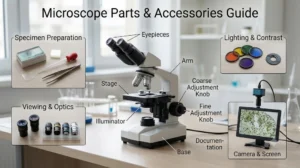
Accessories for Microscopes: A Simple Guide
A microscope only does half the job on its own. The rest depends on the accessories used with it: the slides, lenses, and tools that help you prepare, view, and record what you see. Get these basics right and you save time and get clearer results from day one.
If you are just starting out, it also helps to know what a microscope is and how its main parts work before moving on to accessories.
This guide covers the most common microscope accessories, the main parts of a microscope, the materials you need to get started, and how to pick the right accessories for your work.
What Are Microscope Accessories?
Accessories
Microscope accessories are the tools and add-on parts used alongside a microscope to prepare, view, light, and document a sample. They are not part of the microscope’s core optical system, but they can be important for getting accurate and clear results.
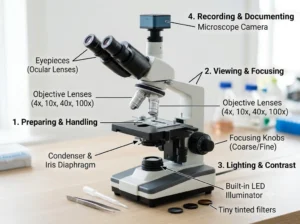
Broadly, microscope accessories help with four things:
- Preparing and handling the specimen (slides, cover slips, tweezers)
- Viewing the sample clearly (eyepieces, objective lenses, filters)
- Lighting the specimen properly (illuminators, condensers)
- Recording and documenting results (microscope cameras)
Choosing the right combination of these depends on your microscope type and what you are trying to observe.
Common Accessories for Microscopes
Here are the accessories you will come across most often when working with a microscope.
Microscope Slides
Slides are thin rectangular pieces of glass or plastic that hold the specimen in place under the lens. A sample is placed on the slide before it is viewed under the microscope.
Cover Slips
Cover slips are thin pieces of glass placed over the specimen on a slide. They protect the sample, keep it flat, and help prevent contamination during viewing.
Eyepieces
The eyepiece, also called the ocular lens, is what you look through. It magnifies the image formed by the objective lens and gives you the final view of the specimen.
Objective Lenses
Objective lenses sit close to the specimen and provide the first stage of magnification. Common magnifications include 4x, 10x, 40x, and 100x.
Microscope Camera
A microscope camera attaches to the eyepiece or trinocular port and allows you to capture images or record videos. It is useful for documentation, teaching, sharing results, and keeping records of samples.
Immersion Oil
Immersion oil is used with high-power, usually 100x, objective lenses. It reduces light scattering and helps produce a sharper image at high magnification.
Mechanical Stage
The mechanical stage holds the slide in place and allows you to move it in small, controlled steps. This makes it easier to scan across a sample without touching the slide directly.
Microscope Illuminator
The illuminator provides light to the specimen so it can be viewed clearly. Depending on the microscope, it may use an LED, halogen bulb, or another light source.
Filters
Filters control the color, intensity, or type of light reaching the specimen. They can improve contrast, reduce glare, or highlight specific features of a sample.
Microscope Cleaning Kit
A cleaning kit usually includes lens paper, cleaning solution, a blower brush, and other basic cleaning tools. Regular cleaning helps keep the lenses clear and the microscope in good condition.
What Are the 12 Parts of a Microscope?
If you are learning the basics, here are the 12 parts you will hear about most often:
- Eyepiece (Ocular lens): The lens you look through; it further magnifies the image.
- Eyepiece tube: Holds the eyepiece in place and connects it to the objective lenses.
- Objective lenses: Provide the first level of magnification.
- Nosepiece (Revolving turret): Holds the objective lenses and lets you switch between them.
- Arm: Supports the microscope body and is used for carrying it safely.
- Stage: The platform where the slide is placed.
- Stage clips: Hold the slide firmly in place.
- Diaphragm (Iris): Controls how much light passes through the specimen.
- Condenser: Focuses light onto the specimen.
- Illuminator: Provides the light source.
- Coarse adjustment knob: Used for quick focusing.
- Fine adjustment knob: Used for precise focusing.
What Are the 20 Main Parts of a Microscope?
For a more detailed look, here are 20 common microscope parts and their functions:
| No. | Microscope Part | Function |
|---|---|---|
| 1 | Eyepiece (Ocular lens) | Magnifies the image for viewing. |
| 2 | Eyepiece Tube | Holds and aligns the eyepiece. |
| 3 | Head (Body) | Houses the optical parts connecting the eyepiece and objectives. |
| 4 | Arm | Supports the microscope body and helps with carrying. |
| 5 | Base | Supports the entire microscope. |
| 6 | Feet | Keep the microscope stable on the work surface. |
| 7 | Illuminator | Provides the light source. |
| 8 | Power Switch | Turns the illuminator on or off. |
| 9 | Diaphragm (Iris) | Adjusts the amount of light reaching the specimen. |
| 10 | Condenser | Focuses light onto the specimen. |
| 11 | Stage | Provides a platform for holding the slide. |
| 12 | Stage Clips | Hold the slide steady on the stage. |
| 13 | Mechanical Stage | Allows controlled movement of the slide. |
| 14 | Objective Lenses | Provide the primary magnification. |
| 15 | Nosepiece (Revolving Turret) | Holds the objective lenses and allows switching between them. |
| 16 | Body Tube | Connects the eyepiece tube to the nosepiece. |
| 17 | Coarse Adjustment Knob | Used for quick focusing. |
| 18 | Fine Adjustment Knob | Used for precise focusing. |
| 19 | Rack Stop | Prevents the stage from moving too close to the objective lens. |
| 20 | Filter Holder | Holds filters used to adjust light quality. |
What Materials Are Needed for a Microscope?
Along with the microscope itself, you will typically need:
- Microscope slides: To hold the specimen.
- Cover slips: To protect and flatten the sample.
- Specimens: The sample you want to observe.
- Dropper: To add water or staining solution to the slide.
- Tweezers: To handle slides and cover slips.
- Cleaning materials: Lens paper and cleaning solution for maintenance.
- Immersion oil: Needed when using compatible high-power objectives.
What Are 10 Things You Can See Under a Microscope?
A microscope opens up a world that is invisible to the naked eye. Some common examples include:
- Plant cells
- Animal cells
- Bacteria
- Fungi
- Pollen
- Hair
- Fabric fibers
- Pond water organisms
- Blood cells
- Small insects or insect parts
How to Choose the Right Microscope Accessories?
Before buying accessories, it helps to check a few basics:
- Microscope type: Accessories differ across compound, stereo, digital, and other microscope types.
- Application: Educational, clinical, and industrial work may require different accessories.
- Sample type: Solid, liquid, and biological samples may need different preparation tools.
- Magnification: High-magnification work may require specific objectives and immersion oil.
- Compatibility: Always check that an accessory fits your specific microscope model.
- Quality: Good-quality slides, lenses, and lighting can improve image clarity and durability.
Conclusion
The right microscope accessories can make microscope work easier and more effective. Slides, cover slips, lenses, lighting, and basic preparation tools are usually enough to get started, while specialised accessories can be added as your work becomes more advanced.
If you manufacture or supply lab equipment and want to find the right microscope and accessories for your application, ALMICRO offers a range of microscope models and related accessories. For questions about choosing the right microscope accessories for your lab, feel free to reach out.