
Autoclave: Working Principle, Uses, Types and Buying Guide
Editorial Note: This guide is published by ALMICRO (Micro Measures & Instruments), a laboratory equipment manufacturer based in Ambala Cantt, Haryana, and in business since 1978. The general autoclave information below follows published steam sterilization guidance, including the U.S. CDC’s Guideline for Disinfection and Sterilization in Healthcare Facilities. Specifications for the AM-145 are taken from the official product page. Cycle times and settings differ by load and by model, so always follow your laboratory’s SOP and the manufacturer’s manual.
Last updated: November 2026.
What Is an Autoclave? 
An autoclave is a sealed pressure vessel that sterilizes materials with saturated steam at high temperature and pressure. It is the standard tool for killing bacteria, viruses, fungi and heat-resistant spores on suitable laboratory materials.
Think of it as a precise, closed cooking chamber for microbiology. Heat-stable items go in. Sterile items come out.
Why Sterilization Matters in Laboratories
A single contaminated flask can ruin a week of culture work. Unsterile glassware can also spoil media, skew results and put staff at risk. Sterilization removes that variable. It is a routine step in microbiology, tissue culture, pharma testing, teaching labs and research facilities.
How an Autoclave Uses Pressurized Steam
Inside the sealed chamber, boiling water produces steam. As steam builds, pressure rises. Higher pressure lets the steam reach temperatures well above 100°C. At about 15 psi (at sea level), saturated steam reaches around 121°C.
Steam then does the real work. It condenses on cooler surfaces, releases a large amount of heat and denatures the proteins that microorganisms need to survive.
Ordinary Heating vs Steam Sterilization
Boiling water stays at 100°C at normal pressure. That kills many germs but does not reliably destroy bacterial spores. Dry heat can sterilize too, but it needs far higher temperatures and much longer exposure.
| Method | Typical temperature | Reliable against spores? | Speed |
|---|---|---|---|
| Boiling water | 100°C | No | Slow |
| Dry heat (hot air oven) | 160°C to 180°C | Yes, with long exposure | Slow |
| Autoclave (steam under pressure) | 121°C and above | Yes, with correct cycle | Fast |
The CDC guideline lists four parameters for steam sterilization: steam, pressure, temperature and time. Miss one and the cycle may fail.
How Does an Autoclave Work? (Working Principle)
The autoclave working principle is simple. Saturated steam is held at a set temperature and pressure for a set time, so it contacts every surface of the load and destroys microorganisms through moist heat.
Portable autoclave cross-section diagram: A simplified illustration can show the domed lid, gasket, safety valve, load rack, water and heating element.
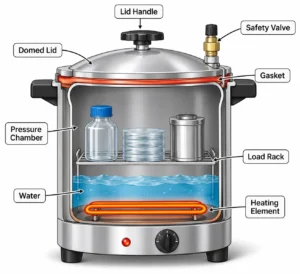
Autoclave diagram
Here is the autoclave sterilization process step by step.
- Step 1: Load suitable materials into the chamber. Add water to the level your manual specifies. Place items so steam can reach all surfaces. Do not pack tightly. Loosen bottle caps and use autoclavable containers only.
- Step 2: Close and seal the autoclave. Fit the lid, check the gasket and secure the fasteners evenly. A poor seal lets steam escape and stops pressure from building.
- Step 3: Generate steam and build pressure. The heating element boils the water. Steam fills the chamber and pushes air out through the vent. This matters because trapped air lowers the real temperature inside the load. Follow your model’s instructions on when to close the vent.
- Step 4: Expose the materials to the required sterilization conditions. Once the chamber reaches the target pressure and temperature, the holding time begins. Common settings are 121°C or 132°C, and the correct time depends on what you are sterilizing. For example, the CDC notes that a 10 lb load of microbiological waste needs at least 45 minutes at 121°C in a gravity displacement unit, because trapped air slows heat penetration.
- Step 5: Release pressure safely and remove materials after cooling. Switch off the heat. Let pressure drop to zero before you open the lid. Liquids need extra care because they can boil over if pressure is released too fast. Use heat-resistant gloves and open the lid away from your face.
Autoclave sterilization process in five steps: Load, close and seal, build steam, hold, release and cool.
Exact times for your lab should come from your SOP, your media supplier’s instructions or your validated cycle. For a deeper walkthrough, see our guide on how to use a portable autoclave and the autoclave temperature, pressure and time explainer.
What Are the Different Types of Autoclaves?
Autoclaves are not one-size-fits-all. Each design suits a different workload. Capacity, controls and installation needs vary widely between types and between manufacturers, so compare models individually.
Portable Autoclave
A portable autoclave is a compact, movable unit, usually with a domed or flat lid and an electric heating element. Water is added by hand. It suits small labs, colleges, clinics and field setups where space and budget are limited.
Vertical Autoclave
A vertical autoclave has an upright cylindrical chamber that you load from the top. It is common in teaching and research labs for glassware, media and general-purpose sterilization. Many models offer larger chambers than portable units, though sizes range widely.
Horizontal Autoclave
A horizontal autoclave has a front-loading, door-style chamber. It is generally built for larger loads and heavier daily use in hospitals, pharma units and big research facilities. It usually needs more floor space and a proper installation.
Tabletop Autoclave
A tabletop autoclave sits on a bench and is often front-loading. It is designed for small instrument loads, which makes it common in clinics and small testing labs. The terms “portable” and “tabletop” overlap between brands, so check the actual specifications.
| Type | Loading style | Typical setting | Space needed |
|---|---|---|---|
| Portable | Top | Small labs, field use, colleges | Low |
| Vertical | Top | Teaching and research labs | Moderate |
| Horizontal | Front | Hospitals, pharma, large labs | High |
| Tabletop | Usually front | Clinics, small instrument loads | Low to moderate |
More on selecting between these in our comparison of portable vs vertical vs horizontal autoclaves.
What Are Autoclaves Used For?
Autoclave uses cover almost any lab task that needs reliable sterilization of heat- and moisture-stable materials.
- Laboratory glassware sterilization: flasks, test tubes, petri dishes, pipettes and beakers.
- Suitable laboratory instruments: stainless steel forceps, scissors, scalpels and other heat-stable tools.
- Microbiology laboratory applications: preparing sterile working conditions for culturing and testing.
- Research and educational laboratories: practical classes, student labs and institutional research work.
- Preparation of laboratory materials: pipette tips, filter assemblies, aqueous solutions and autoclavable containers.
- Culture media sterilization: nutrient agar, broths and other media that tolerate steam.
Some items should never go in. Heat-sensitive plastics, flammable or volatile solvents, corrosive chemicals and oily or powdery materials that steam cannot penetrate are not suitable. Check the label of plastics before loading. If it does not say autoclavable, assume it is not.
Important Features to Consider When Buying an Autoclave
A good autoclave machine is a long-term lab asset. Compare these points before you decide.
Operating Pressure
Pressure sets the steam temperature. Check that the unit’s range covers the cycle your work needs. Many general lab cycles use about 15 psi.
Chamber Material and Construction
Stainless steel resists corrosion and is easy to clean. Aluminium is lighter and conducts heat well. Look for a sturdy body with clean construction and check how many joints or seams the chamber has.
Lid and Gasket Sealing
The lid and gasket decide whether the chamber holds pressure. Look for a gasket that seats evenly and can be replaced when worn. Secure fasteners such as wing nuts or hinged bolts make sealing easier.
Safety Valve and Pressure Regulation
A safety valve releases steam if pressure goes above a safe limit. Never buy a unit without one. A pressure regulation mechanism also helps keep cycles consistent.
Electrical Requirements
Confirm the voltage, frequency and phase match your lab’s supply. In India, many portable units run on 220V AC, 50Hz, single phase. Check the plug, cord and power rating before you order.
Ease of Operation and Maintenance
Simple controls reduce user error. Ask about spare gaskets, valve replacement and service support. A unit that is easy to clean and maintain lasts longer.
ALMICRO Portable Autoclave AM-145: Features and Specifications
The ALMICRO Portable Autoclave AM-145 is a vertical-body portable autoclave designed for general laboratory sterilization. It combines jointless construction with a spring-loaded safety valve and a simple domed cover.
| Specification | Product details |
|---|---|
| Model | AM-145 |
| Product type | Portable Autoclave |
| Body material | Stainless steel or aluminium |
| Construction | Vertical body with no joints |
| Pressure range | 15 to 18 PSI |
| Lid | Domed cover |
| Gasket | Jointless gasket |
| Safety mechanism | Spring-loaded safety valve |
| Power supply | 220V AC, 50Hz, single phase |
Additional features:
- Wing nuts and hinged bolts for securing the cover.
- Threaded cap for pressure adjustment.
- Supplied with plug and cord.
- Designed for general laboratory sterilization.
The jointless body and gasket mean fewer seams to inspect. The spring-loaded safety valve is there to relieve excess pressure. The 15 to 18 PSI range includes the 15 psi commonly used for general laboratory cycles. For quotes, availability and model details, contact the ALMICRO team using the details at the end of this guide.
How to Choose the Right Autoclave for Your Laboratory?
Use this checklist before you shortlist models.
- Understand your sterilization requirements. List what you sterilize every week: glassware, media, instruments or waste. This decides the cycle and the type.
- Check the chamber size and capacity. Estimate your largest and most frequent load. Confirm the chamber capacity with the supplier, since it is not always listed on a basic spec sheet.
- Compare pressure range and construction material. Match the pressure to your cycle. Choose stainless steel or aluminium based on budget and use.
- Check the safety mechanisms. Look for a safety valve, secure lid fastening and a reliable gasket.
- Consider electrical compatibility and maintenance. Match voltage and phase. Ask about spares and support.
Also see our wider range of laboratory equipment and other laboratory sterilization equipment.
Frequently Asked Questions About Autoclaves
1. What Is an Autoclave Used For?
An autoclave is used to sterilize laboratory glassware, heat-stable instruments, culture media and aqueous solutions using steam under pressure. It is also used to decontaminate suitable lab waste before disposal, following local biomedical waste rules. Schools, hospitals, pharma units and research labs all rely on it.
2. What Is the Working Principle of an Autoclave?
An autoclave works by holding saturated steam at a set temperature and pressure for a set time inside a sealed chamber. The pressure raises the steam temperature above 100°C. The hot steam condenses on the load and destroys microorganisms, including heat-resistant spores.
3. How Does Steam Sterilization Work?
Steam sterilization kills microorganisms by exposing them to direct contact with saturated steam at high temperature. Moist heat denatures proteins and enzymes that organisms need to live. The four parameters that must be met are steam, pressure, temperature and time. Removing air from the chamber is also essential.
4. What Is the Normal Pressure Range of an Autoclave?
Most general laboratory autoclaves run at about 15 psi, which gives roughly 121°C at sea level. Some units operate at higher pressures for shorter cycles at 132°C or above. The ALMICRO AM-145 lists a pressure range of 15 to 18 PSI.
5. What Is the Difference Between a Portable and Vertical Autoclave?
Both load from the top, but a portable autoclave is generally smaller, lighter and easier to move, with manual water filling. A vertical autoclave is usually a larger, floor-standing unit with a bigger chamber. Capacity and features vary by model, so compare specifications directly.
6. Why Is a Safety Valve Important in an Autoclave?
A safety valve releases steam automatically if pressure rises above a safe limit. It protects the operator and the equipment from over-pressurization caused by faults or blocked vents. An autoclave without a working safety valve should not be used.
7. Which Materials Can Be Sterilized in an Autoclave?
Heat- and moisture-stable materials can be autoclaved. These include borosilicate glassware, stainless steel instruments, culture media, aqueous solutions and autoclavable plastics such as polypropylene when labelled as such. Avoid flammable solvents, corrosive chemicals, polystyrene and any item that is not rated for steam.
Conclusion
Sterilization protects your results, your samples and your team. A dependable autoclave makes that protection routine. Understand the working principle, match the type to your workload and check the pressure, construction, sealing and safety features before you buy.
For general laboratory use, the ALMICRO Portable Autoclave AM-145 offers a jointless vertical body, a spring-loaded safety valve and a 15 to 18 PSI range. It is a practical option when you need a straightforward unit for everyday sterilization.
Laboratory Equipment Enquiries – ALMICRO
Phone: +91 70822 94902
Email: inq@almicroinstruments.com
Website: ALMICRO Instruments
Address: #444, Arya Nagar, Jagadhari Road, Ambala Cantt-133001, Haryana
1 Comment.
[…] Autoclave: Working Principle, Uses, Types and Buying Guide […]