
Hot Air Oven: Principle, Parts, Uses & Temperature Guide
Note: this article is based on well-researched, factual information, not promotional content. It explains how a hot air oven works and what matters when using or choosing one, without pushing any product.
| Hot Air Oven | |
|---|---|
| Type | Dry heat sterilizer |
| Chamber range | 50°C – 300°C |
| Sterilization range | 150°C – 180°C |
| Heat transfer | Conduction & convection |
| Common loads | Glassware, metal instruments, oils, powders |
| Related method | Autoclave (moist heat) |
A hot air oven is a laboratory device that sterilizes glassware, metal instruments, and other heat-stable materials using dry heat instead of steam. It heats a sealed chamber to temperatures between 150°C and 180°C, holding that temperature long enough to destroy bacteria, spores, and their toxins through oxidation rather than moisture. Because no water is involved, it’s the preferred method for sterilizing items that steam would damage, or that need to stay completely dry afterward: oils, powders, and glass meant to hold liquid. This guide covers how it works, what’s inside it, and how to choose one for a lab.
- What Is a Hot Air Oven?
- Hot Air Oven Working Principle
- Hot Air Oven Parts (With Diagram)
- Hot Air Oven Temperature & Time
- Hot Air Oven Types: Static vs Forced Air
- Hot Air Oven Uses & Applications
- Big Size Hot Air Oven: How to Choose the Right Capacity
- Hot Air Oven Advantages and Limitations (vs Autoclave)
- What to Look for in a Laboratory Hot Air Oven
- Hot Air Oven FAQs
What Is a Hot Air Oven?
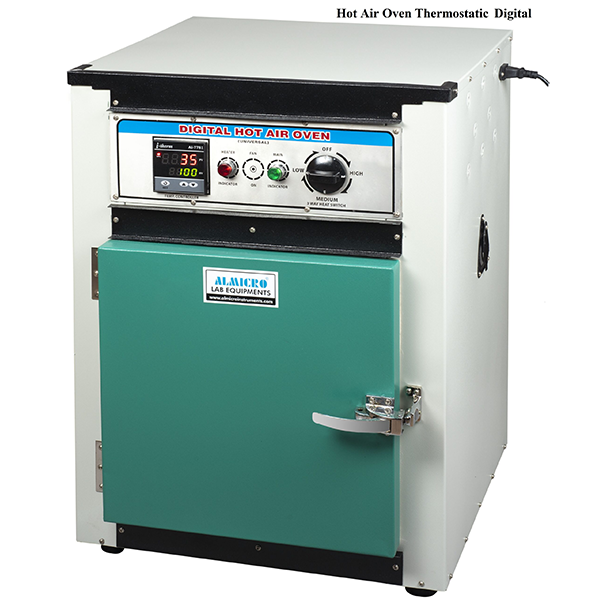
hot air oven
A hot air oven is an electrically heated, thermostatically controlled chamber used to sterilize or dry laboratory materials using dry heat rather than steam or radiation. Chamber temperatures typically range from 50°C to 300°C, though sterilization cycles specifically run between 150°C and 180°C. Because it relies on hot air rather than pressurized steam, it’s also known as a dry heat sterilizer, dry heat oven, or hot air sterilizer, and it sits in a different sterilization category from an autoclave, which achieves the same end result using pressurized steam at 121 to 134°C.
The materials it’s built for are things that can tolerate sustained high heat but not moisture: glassware, metal instruments, powders, and anhydrous oils. Since it doesn’t rely on pressure the way an autoclave does, its chamber can be a simpler insulated box rather than a pressure vessel, which is part of why hot air ovens are generally lower-cost and simpler to maintain. The trade-off is temperature and time: air is a far less efficient carrier of heat than steam, so a hot air oven has to run hotter and hold that temperature far longer to reach the same sterilization result an autoclave gets to in minutes.
It’s also easy to confuse with a laboratory incubator, since both are insulated, thermostatically controlled chambers. The two do opposite jobs, though. An incubator holds a low, stable temperature, usually well under 60°C, to grow or preserve living cultures. A hot air oven does the reverse: it applies high heat specifically to kill microorganisms and drive off moisture, not sustain living organisms. A quick way to tell them apart on a lab bench: if something is growing inside it, it’s an incubator; if something is being sterilized or dried, it’s a hot air oven.
Hot Air Oven Principle
A hot air oven sterilizes through two combined processes: conduction and convection.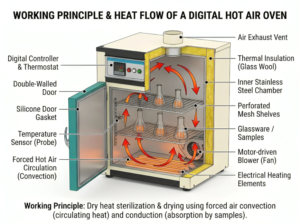
Electric heating coils inside the chamber generate heat. That heat first warms the air around the coils, and the air transfers heat to the surface of whatever is inside the chamber: glassware, metal trays, sealed containers of powder. This transfer into the material’s surface is conduction. From there, heat moves inward from the surface toward the core of the item, layer by layer, until the whole object reaches the set temperature. This inward movement is why holding time matters: the surface heats fast, but the center takes longer to catch up.
Convection is what moves the hot air itself. In a static air oven, convection happens passively: heated air rises because it’s less dense, cooler air sinks to replace it, and this natural cycle spreads heat through the chamber. It works, but unevenly; air near the heating coils can run several degrees hotter than air at the top shelf. A forced air oven adds a fan that actively circulates hot air, which flattens out that difference and cuts the time needed to reach a uniform chamber temperature.
Once the target temperature is held long enough, heat destroys microorganisms by oxidizing their cell components and denaturing their proteins, not by boiling or steaming them, since no moisture is involved. This is why the process takes longer than autoclaving: dry heat has to do the same job as steam, without water’s efficiency at moving energy.
Hot Air Oven Parts (With Diagram)
Hot Air Oven Diagram (Labelled Parts)
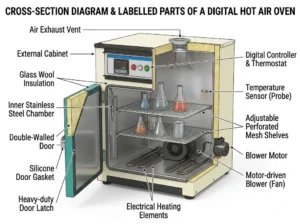
hot air oven labelled parts, cross-section
- Insulated double-walled chamber
- Holds heat inside and keeps the outer casing cool to the touch during operation.
- Electric heating element
- Coils, usually at the base or sides, that convert electricity into heat.
- Fan (forced air models)
- Circulates hot air to keep temperature uniform across shelves.
- Thermostat
- Switches the heating element on and off to hold the set temperature.
- Temperature sensor (PT-100)
- Measures chamber temperature and feeds it to the controller.
- Digital/PID controller
- Displays and sets temperature and hold time; PID models adjust heating more precisely than basic on/off types.
- Adjustable shelves/trays
- Perforated or wire shelves that let air circulate around items.
- Door with locking mechanism
- Seals the chamber; some models interlock to prevent opening mid-cycle.
- Air vents
- Small openings that let moisture and gases escape during the cycle.
Almicro’s hot air ovens include all of these as standard, across both benchtop and industrial floor models.
Hot Air Oven Temperature & Time
Sterilization time depends on temperature: the higher the temperature, the shorter the hold time needed for the same result. Hold times below are measured from the moment the entire load reaches the set temperature, not from when the display first shows it.
| Temperature | Holding Time |
|---|---|
| 180°C | 20 minutes |
| 170°C | 30 minutes |
| 160°C | 60 minutes |
| 150°C | 150 minutes |
160°C for 60 minutes is the most commonly used cycle for general lab glassware and instruments; it balances cycle time against energy use. 150°C is used when a load includes items best kept off higher temperatures. Below 150°C, dry heat isn’t considered reliable for killing bacterial spores, so it isn’t used for sterilization cycles.
These figures cover the holding period only. The full cycle, including heat-up time and cool-down before the door opens, usually runs 4 to 10 hours depending on load size and oven type. Opening the door while a load is still hot, especially glassware, risks thermal shock and cracking.
Hot Air Oven Types: Static vs Forced Air
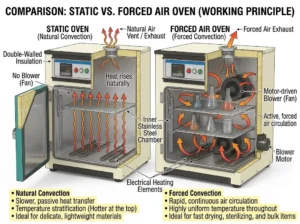
- Static air (gravity convection) oven
- Relies on natural air movement: heat rises from coils at the bottom, cooler air sinks to replace it. No fan. Heat distribution is less even, and reaching a stable temperature across all shelves takes longer.
- Forced air (mechanical convection) oven
- Uses a fan to actively circulate hot air through the chamber. Temperature stays more uniform between shelves, and cycles typically run faster than static models for the same load.
-
static vs forced air oven comparison
Most labs running routine sterilization across multiple shelves use forced air ovens for the more consistent results. Static air ovens are simpler, generally cost less, and remain adequate for smaller loads or single-shelf use where uneven heating matters less. Almicro manufactures both static and forced-air ovens, so the choice comes down to load size and shelf count rather than availability.
Hot Air Oven Uses & Applications
- Medical & hospital labs
- Sterilizing glassware, metal instruments, and swabs used in diagnostics and pathology.
- Medical colleges & universities
- Routine sterilization of lab equipment for teaching and research.
- Pharmaceutical manufacturing
- Sterilizing glass containers and depyrogenating vials before aseptic filling; dry heat destroys bacterial endotoxins that autoclaving can’t remove.
- Biotechnology & microbiology labs
- Sterilizing petri dishes, pipettes, test tubes, and culture equipment.
- Research institutes
- Sterilizing instruments and drying glassware between experiments where residual moisture would affect results.
- Industrial QC labs
- Sterilizing sample containers and testing equipment.
- Food & environmental testing labs
- Preparing sterile containers and utensils for sample collection.
- Veterinary & diagnostic labs
- Sterilizing instruments used in animal testing and sample handling.
Anywhere moisture would interfere with an item’s use afterward, glass meant to hold liquid, powders, anhydrous oils, a hot air oven is the standard choice over an autoclave. Almicro, a laboratory equipment manufacturer in India, supplies ovens across most of these settings, including medical colleges, diagnostic labs, pharmaceutical manufacturers, and industrial QC facilities.
Big Size Hot Air Oven: How to Choose the Right Capacity
Oven capacity should match the volume of material a lab actually processes per cycle, not the size of the lab itself.
- If a lab handles a small daily volume of glassware, such as a clinic, a small diagnostic lab, or a single research bench, a benchtop oven in the 20 to 50 litre range is usually enough.
- If a lab runs multiple sterilization batches a day across several technicians, such as a hospital or teaching lab, a mid-size oven in the 100 to 200 litre range avoids constant reloading.
- If a facility sterilizes in bulk, a manufacturing QC lab, a central sterile supply department, or an industrial testing lab, a 300-litre-plus floor-standing oven with multiple shelves cuts down on cycle count.
Undersized ovens force more cycles per day, which adds up in electricity and staff time. Oversized ovens waste energy heating unused chamber space. Matching capacity to actual daily load, with some headroom for peak days, is the more efficient choice either way. Almicro’s range spans this full scale, from 20-litre benchtop units to 300-litre-plus industrial models, so sizing is usually a matter of matching capacity rather than comparing across suppliers.
Hot Air Oven Advantages and Limitations (vs Autoclave)
| Hot Air Oven (Dry Heat) | Autoclave (Moist Heat) | |
|---|---|---|
| Kills microorganisms by | Oxidation, protein denaturation | Protein coagulation via steam |
| Typical temperature | 160–180°C | 121–134°C |
| Typical holding time | 20–150 minutes | 3–30 minutes |
| Total cycle time | 4–10 hours | 30–60 minutes |
| Penetrates oils & powders | Yes | No |
| Corrodes metal instruments | No | Possible with repeated use |
| Damages rubber & plastic | Yes | Less so |
| Destroys bacterial endotoxins | Yes | No |
Dry heat’s advantages come from what it doesn’t add: no water means no corrosion, no residual moisture, and full penetration into oils and powders that steam can’t reach. Its main drawback is time; a full cycle takes hours, not minutes, and it’s unsuitable for anything that melts, chars, or degrades under sustained high heat, including most plastics and rubber.
What to Look for in a Laboratory Hot Air Oven
- PID digital controller
- Holds temperature more precisely than a basic on/off thermostat, which matters for repeatable results.
- PT-100 or equivalent RTD sensor
- More accurate and stable than standard thermocouples over long cycles.
- Forced air circulation
- A fan reduces temperature variance between shelves, useful beyond single-shelf use.
- Double-walled insulated chamber
- Keeps the exterior safe to be near and reduces heat loss, lowering running cost.
- Over-temperature safety cutoff
- Shuts off heating if the chamber exceeds a safe limit, protecting the load and the unit.
- Calibration certificate
- Confirms the sensor and controller were tested against a traceable standard before dispatch.
- Capacity matched to daily load
- Oversized wastes energy; undersized forces extra cycles.
- Manufacturer support and spare parts availability
- Matters more over a 10+ year equipment life than any single feature.
Almicro provides calibration certification and after-sales support as standard across its hot air oven range, covering two of the checklist points above.
Hot Air Oven FAQs
What temperature kills bacteria in a hot air oven?
Most bacteria and their spores are destroyed at 160°C held for 60 minutes, the standard sterilization cycle. Higher temperatures work faster: 170°C needs 30 minutes, 180°C about 20. Temperatures below 150°C aren’t considered reliable for killing spores.
Hot air oven vs autoclave, what’s the difference?
A hot air oven sterilizes with dry heat at 160 to 180°C over hours. An autoclave uses pressurized steam at 121 to 134°C in under an hour. Autoclaves suit aqueous solutions and rubber; hot air ovens suit glassware, oils, powders, and anything that must stay dry.
How long does sterilization take?
Holding time alone ranges from 20 minutes at 180°C to 150 minutes at 150°C. Including warm-up and cool-down, a full cycle typically runs 4 to 10 hours depending on load size and oven type.
Is a hot air oven the same as an incubator?
No. An incubator holds a low, stable temperature to grow or preserve living cultures. A hot air oven applies high heat, generally 150°C and above, specifically to kill microorganisms rather than sustain them. They serve opposite purposes.
What materials should not be sterilized in a hot air oven?
Rubber, most plastics, and surgical dressings or fabrics shouldn’t go in a hot air oven; they char, melt, or degrade at sterilization temperatures. Aqueous solutions also aren’t suitable, since the process assumes no moisture in the load.
Related Blogs :
Biology Laboratory Equipment Manufacturer in India
top 10 laboratory equipment manufacturers in India
Medical College Lab Equipment Manufacturer in India
Hospital Laboratory Equipment Manufacturer in India
Explore our : Heating, Refrigiation & General Equipments
Hot air ovens are widely used in laboratories for dry-heat sterilization of suitable materials such as glassware and powders. For a general reference, you can also explore the Hot Air Oven article on Wikipedia.