
Description
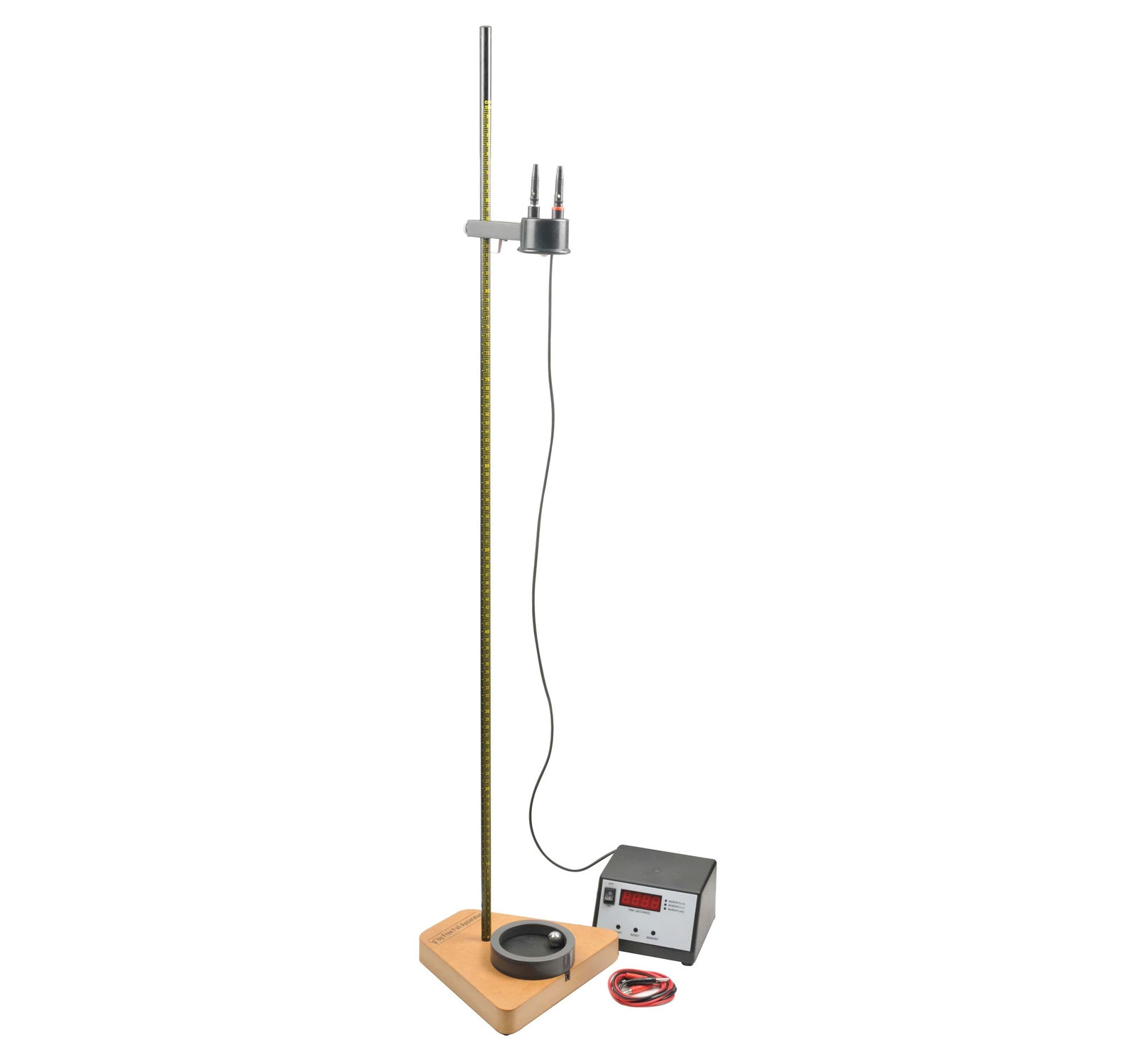
“G” BY Free Fall Apparatus – Technical Specifications & Features
Technical Specifications
| Specification | Details |
|---|---|
| Model | ‘G’ BY Free Fall Apparatus |
| Measurement | Acceleration due to gravity (g) |
| Spheres | 2 high-quality steel spheres |
| Electromagnet | Holds sphere securely at the starting position |
| Timer | Digital timer for precise measurement |
| Height Measurement | Graduated scale on the column for accurate height reading |
| Connections | Socket connections for electromagnet and timer |
| Safety | Sphere held firmly on contact plate to prevent bouncing |
| Construction | Durable, compact plastic molded case |
| Use | Ideal for physics experiments in laboratories and classrooms |
Key Features
-
Provides accurate measurement of acceleration due to gravity (g).
-
Simple setup and easy operation, suitable for students and researchers.
-
Comes with two steel spheres for repeated experiments.
-
Electromagnet holds the sphere at the starting position for consistency.
-
Digital timer ensures precise timing of the fall.
-
Contact plate prevents bouncing for reliable measurements.
-
Graduated height scale on the column for quick and clear readings.
-
Socket connections allow easy integration of the magnet and timer.
-
Compact, sturdy plastic molded case ensures durability and portability.
-
Safe and reliable for classroom demonstrations and lab experiments.
Working Principle
The “G” BY Free Fall Apparatus operates on the principle of free fall. A steel sphere is initially held at the top by an electromagnet. When the magnet is deactivated, the sphere is released and falls freely under gravity. The digital timer starts automatically as the sphere is released and stops when it contacts the bottom plate, ensuring accurate timing. The fall height is measured using the column’s scale, and with the measured time, the acceleration due to gravity (g) can be precisely calculated.
Applications / Use Cases
-
Physics Laboratories: Demonstrating free fall and gravity experiments.
-
Colleges & Universities: Teaching concepts of motion and acceleration.
-
Research Centers: Experiments on acceleration, motion, and dynamics.
-
Schools: Practical science experiments for students.
-
Training Labs: Hands-on demonstrations for physics instructors and learners.
Reviews
There are no reviews yet.