
Where Can You Find a Reliable Student Microscope Supplier in India? A Guide for Schools and Colleges

A reliable student microscope supplier in India is a manufacturer or dealer that provides classroom-
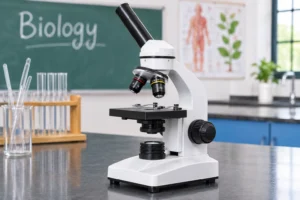
Student microscope used in a school biology laboratory.
ready microscopes with clear optics, durable construction, spare-part availability and dependable after-sales support. Schools and colleges should compare these four points before they compare prices.
A microscope turns a textbook diagram into something students can see for themselves. A student who watches onion peel cells come into focus understands cell structure faster than one who only reads about it. That is why every science lab needs microscopes matched to the age and skill of its students.
The supplier matters as much as the instrument. It decides whether you get consistent quality across 20 or 60 units and someone to call when one fails. This guide covers microscope types, features and buying steps, and compares five Indian companies, including ALMICRO, an Ambala Cantt manufacturer that serves educational institutions.
What Is a Student Microscope and How Does It Work?
A student microscope is a compound optical microscope built for classroom and laboratory teaching, with simple controls, durable parts and enough magnification to observe cells and prepared slides.
It works in three steps. A light source (a mirror or an LED) shines through the specimen. The objective lens forms a magnified image. The eyepiece magnifies that image again. Total magnification is the eyepiece power multiplied by the objective power, so a 10x eyepiece with a 40x objective gives 400x.
Students use it to observe plant cells, animal cells, microorganisms and prepared slides. Because these instruments face daily handling, educational models favour sturdy builds over advanced features. A student light microscope, which relies on visible light, covers most routine practicals. For optics background, Nikon MicroscopyU offers free technical tutorials.
Different Types of Microscopes Used by Students
Each type below serves a different teaching purpose.
Compound Student Microscope
It is designed for thin biological specimens and is the standard choice in school and college biology labs. Students use it for plant cells, animal cells and prepared slides. ALMICRO lists compound student models such as the BM-3 and the BM-3A, which has a die-cast monocular body inclinable to 90 degrees.
Monocular Student Microscope
A monocular model has one eyepiece and very simple operation. It suits basic classroom demonstrations and individual practical work, and it is the usual choice when a school needs many units on a limited budget.
Binocular Student Microscope
Two eyepieces reduce eye strain during longer sessions. That makes binocular models a better fit for senior classes and advanced laboratories, where students spend extended time at the stage.
Student Light Microscope
This type uses visible light. The light source, condenser and objective lenses work as a chain. The condenser concentrates light on the slide, and the objective forms the image. Routine school and college experiments depend on this setup.
Digital Microscope for Students
A digital microscope shows the specimen on a screen and supports image capture. A whole bench can view the same field, which helps group learning and record keeping. ALMICRO’s digital LCD microscopes include the DVM-01 with a 7-inch LED display.
Understanding a School Microscope Diagram: Main Parts and Their Functions
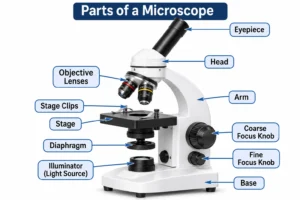
Labelled school microscope diagram showing eyepiece, objective lenses, stage and focus knobs.
A labelled school microscope diagram is the quickest way to learn the instrument before touching it. Use it to match each part to its job:
- Eyepiece: The lens students look through.
- Objective lenses: Provide different magnification levels.
- Revolving nosepiece: Holds and rotates the objective lenses.
- Stage and stage clips: Support the slide and keep it in position.
- Condenser: Focuses light onto the specimen.
- Illuminator or mirror: Provides the light.
- Coarse adjustment knob: Brings the image roughly into focus.
- Fine adjustment knob: Sharpens the image.
- Arm and base: Give the structure its support.
In practicals, ask students to start with the lowest-power objective and use only the coarse knob there. At higher power they should switch to the fine knob. This habit protects both the slide and the lens.
How to Choose the Right Microscope for Students at Different Education Levels
Buyers often search for the best student microscope supplier in India, but no single supplier is best for every lab. Start with the learners, then match the supplier to them.

Students using microscopes in a school and college practical session.
Microscope for School Students
A microscope for students in the lower classes needs easy controls, basic magnification and a durable body. Simple illumination and a straightforward focusing system are enough for introductory biology experiments. Rough handling is normal, so robustness matters most.
Microscope for Higher Secondary Students
Senior students need a choice of objective lenses and finer focusing. The microscope should handle prepared slides well and feel comfortable during practical examinations, when students must work quickly.
College Microscope Requirements
A college microscope needs stronger optical performance and several magnification options. Binocular or trinocular heads help where needed, and digital imaging adds value for teaching and research. ALMICRO’s BM-8bi fits this level. It is a binocular model with an inclined body, a rotatable head, LED illumination and battery backup.
What Features Should You Check Before Buying a Student Microscope?
Compare student microscopes on these eight points:
- Magnification: Check the available eyepiece and objective combinations.
- Optical quality: Look for clear, sharp images across the field.
- Illumination: LED lighting lasts longer and runs cooler than older lamp systems.
- Focusing mechanism: Coarse and fine controls should move smoothly.
- Stage design: Slides must sit securely.
- Build quality: The body must survive regular classroom handling.
- Ease of maintenance: Ask about cleaning needs and spare parts.
- Warranty and service: Get the support terms in writing.
Student Microscope Suppliers in India: Companies to Explore
Searching for a top student microscope supplier in India returns many names. The five below are a starting point for your own checks. Their order is not a ranking, and the details come from public product listings, so confirm current models and availability with each company.
ALMICRO (Micro Measures & Instruments)
Established in 1978, ALMICRO manufactures microscopes in Ambala Cantt, Haryana, widely known as India’s Science City. Its catalogue runs to 350+ microscope models. The student range sits in the Dissecting and Student Microscopes category. It includes the BM-2 junior student, BM-3 and BM-3A compound student, and BM-4 junior medical microscopes, plus MD-series dissecting models.
For senior classes and colleges, ALMICRO also lists the monocular BM-6mo and binocular models such as the BM-8bi and BM-9Bi. Request a quotation: Share your quantity and class level on +91 70822 94902.
Radical Scientific
Radical Scientific Equipments Pvt. Ltd. is an Ambala Cantt manufacturer. Its listings include the RM-2A student compound microscope, the RM-3 monocular student microscope and the RSM-1 student stereo microscope, alongside metallurgical models. Its range suits institutions that want compound and stereo options from one source.
Magnus Opto Systems
Magnus Opto Systems India Pvt. Ltd. is a microscope manufacturer with a listed Noida address. Its range covers student monocular models, compound binocular models such as the MLXi Plus, and trinocular models with USB camera options. The HM-100 student monocular lists LED illumination with battery backup, a practical feature for labs with unreliable power.
Weswox
Weswox is a microscope and laboratory equipment brand from Ambala Cantt. Its portfolio includes centrifuges and histopathology equipment, and its microscope listings include junior student and dissecting models alongside binocular, trinocular and fluorescence research models. It suits institutions that want microscopes and other lab equipment from one supplier.
Dewinter Optical
Dewinter Optical Inc. is a New Delhi manufacturer of microscopes and image analysis software. Its strength is digital imaging: microscope cameras, digital LCD microscopes, and fluorescence and stereo zoom models. It focuses less on basic student models, so it fits best where a college wants digital imaging for teaching.
Student Microscope vs. Professional Laboratory Microscope: What Is the Difference?
| Comparison factor | Student microscope | Professional laboratory microscope |
|---|---|---|
| Primary use | Basic learning and practical classes | Clinical, research and specialised laboratory work |
| Operation | Generally straightforward | May include advanced controls |
| Optical features | Designed for educational observation | Depends on the specialised application |
| Configuration | Often monocular or binocular | Binocular, trinocular or specialised |
| Typical users | School and college students | Researchers, technicians and laboratory professionals |
An advanced microscope is not always necessary. A basic onion peel practical gains nothing from a research-grade trinocular head. Match the instrument to the syllabus.
Common Experiments Students Perform Using Microscopes
The right features make these practicals easier:
- Onion peel and plant cells: Smooth fine focus and good contrast at moderate power.
- Animal cells: Stable illumination and a secure stage.
- Microorganisms in prepared samples: Higher magnification and sharp objectives.
- Prepared tissue slides: Even lighting from a well-adjusted condenser.
- Cell structures and basic biological processes: Consistent optics, so every student sees the same detail.
How Schools and Colleges Can Purchase Microscopes in Bulk
- Estimate how many microscopes you need.
- Decide how many students will share each unit.
- Select the configuration: monocular, binocular or digital.
- Check that every unit in the batch has identical specifications.
- Ask for a bulk quotation and a delivery timeline.
- Confirm warranty, servicing and spare-part availability.
- Request a demonstration or technical specification sheet.
Frequently Asked Questions
Which microscope is best for students?
A compound light microscope with achromatic objectives, LED or mirror illumination and smooth focusing. Monocular models suit schools. Binocular models suit senior classes and colleges.
What is a student light microscope?
It is a compound microscope that uses visible light and lenses to magnify thin specimens. Schools and colleges use it for routine biology practicals.
What type of microscope is suitable for school laboratories?
A durable compound monocular microscope with a 10x eyepiece, a few objective lenses and simple illumination works well for most school laboratories.
What is the difference between a school microscope and a college microscope?
School models stress simplicity, durability and basic magnification. College models offer better optics, more magnification options and often binocular or digital configurations.
What magnification is suitable for student microscopes?
Most school work needs about 40x to 400x. Colleges often need up to 1000x for detailed observation of cells and microorganisms.
What are the main parts of a student microscope?
The main parts are the eyepiece, objective lenses, revolving nosepiece, stage, stage clips, condenser, illuminator or mirror, focus knobs, arm and base.
How does a microscope help students in biology practicals?
It lets students observe cells, microorganisms and tissues directly. This links classroom theory to evidence and builds the observation skills practical exams test.
Where can schools buy student microscopes in India?
Schools can buy from manufacturers and authorised suppliers, including firms in Ambala Cantt and Delhi NCR. Request specifications and quotations from several suppliers before deciding.
What should colleges check before purchasing microscopes in bulk?
Check identical specifications across units, warranty terms, spare-part supply, delivery timelines and service support. Ask for a demonstration before placing the order.
Find the Right Student Microscope for Your Educational Laboratory
The right microscope depends on your students’ level and your practical syllabus. Optical quality, ease of use, durability and service support matter more than a long feature list. A reliable student microscope supplier in India helps you get all four across every unit.
ALMICRO offers compound, binocular and digital microscope options for school and college laboratories. Share your required quantity and specifications before requesting a quotation.
Contact ALMICRO to explore microscope options for school and college laboratories:
Phone: +91 70822 94902
Address: #444, Arya Nagar, Jagadhari Road, Ambala Cantt-133001, Haryana.
Refrence blogs : [ Leading microscope manufacturer in india | No.1 Microscope & Laboratory Equipment Manufacturer in India. | What is microscope ]