
Which Microscope Is Best for Research?
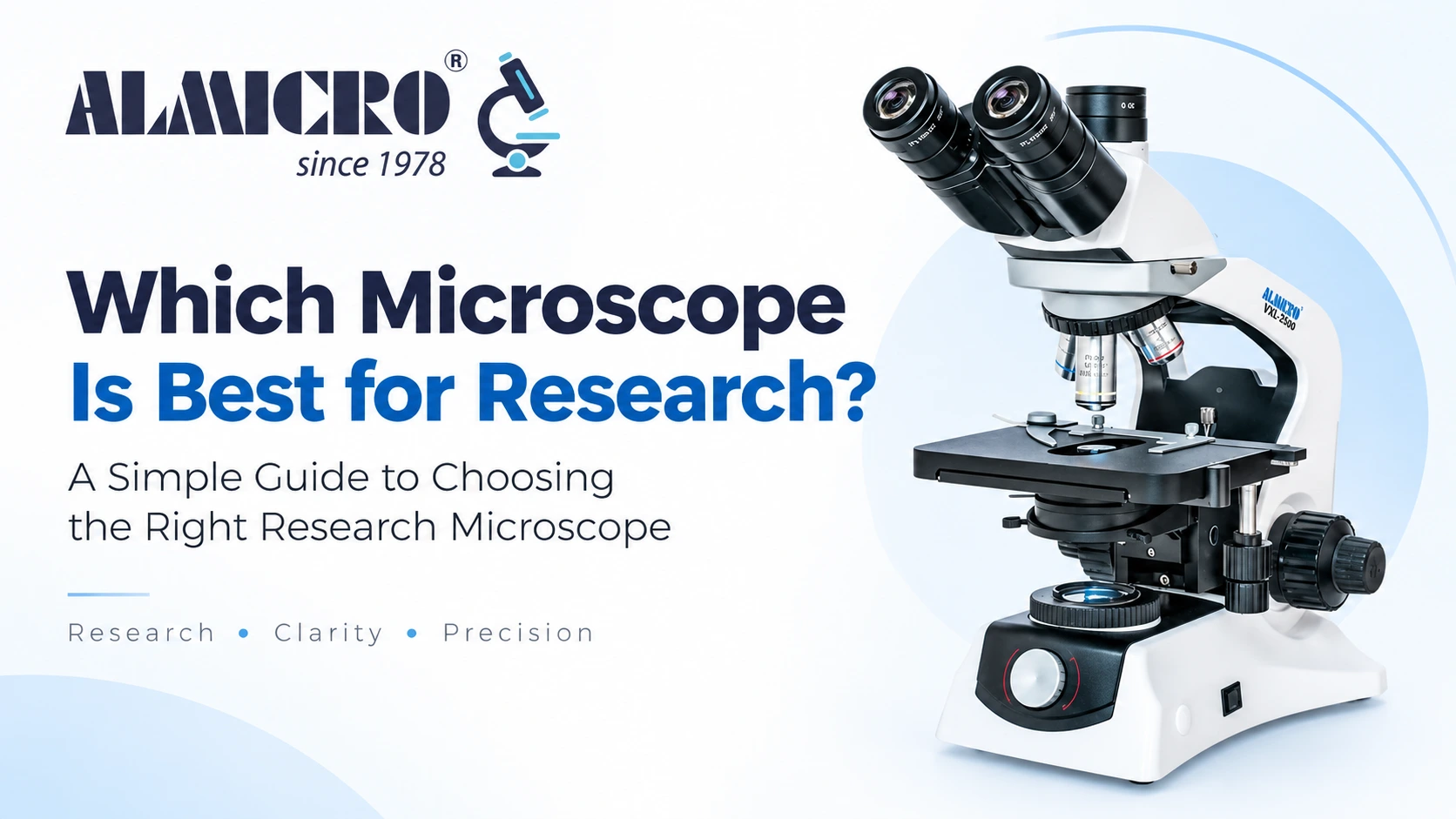
There is no single research microscope that suits every application. The right choice depends on your specimen type, observation technique, required magnification, imaging needs and research field. A microbiology lab and a materials testing lab need very different systems, even though both are doing serious research.
Research microscopes are used across life science research, medical laboratories, microbiology, pathology, material science and pharmaceutical research. This guide will help you match the right microscope type to the work you actually do.
What Is a Research Microscope?
A research microscope is a high-resolution laboratory instrument built for detailed, repeatable scientific observation, with better optics and more configuration options than a standard educational microscope.
The difference shows up in the details. Research-grade systems use higher quality optical glass, sharper objectives and more precise focusing mechanisms. Most offer a trinocular head so a camera can be attached for documentation and measurement.
They are also expandable. You can add phase contrast attachments, fluorescence modules, polarizing accessories or digital imaging later, without replacing the entire stand. That matters when research requirements change over time.
Which Type of Microscope Is Best for Research?
The honest answer is that it depends on what you are looking at. Here are the five systems that cover most laboratory research work.
Research Trinocular Microscope
This is the general purpose workhorse for biological and laboratory research. It handles bright-field observation of stained slides, blood smears, tissue sections and prepared specimens.
The trinocular port lets you attach a camera for image capture, measurement and record keeping. For routine research where documentation matters, this is usually the practical starting point.
Phase Contrast Microscope
Best for living cells, tissue culture and transparent specimens.
Phase contrast converts small differences in refractive index into visible contrast. In plain terms, it lets you see unstained, living material clearly. No heavy staining required, so the cells stay alive while you observe them. That makes it a standard choice for cell biology and culture monitoring. Read more in our phase contrast microscope guide.
Fluorescence Microscope
Best for molecular biology, immunology and cell biology.
Fluorescence systems use specific excitation wavelengths to make fluorescent-labelled structures glow against a dark background. Antibody staining, DNA probes and live-cell markers all rely on this. If your protocols involve FITC, DAPI, TRITC or similar dyes, you need a dedicated fluorescence setup. See our fluorescence microscope guide for filter and illumination details.
Inverted Research Microscope
Best for cell culture work.
The optics sit below the stage, so you can observe cells directly through the bottom of Petri dishes, culture flasks and multi-well plates. No need to disturb the culture. Live-cell observation over days or weeks becomes practical.
Metallurgical Microscope
Best for metals, electronics and material science.
These use reflected light rather than transmitted light, because metal samples are opaque. Grain structure, surface defects, coatings, weld quality and PCB inspection all fall under this category.
What Features Should a Good Research Microscope Have?
Specifications matter more than marketing claims. Here is what to check before you buy.
- Infinity-corrected optical system, which allows accessories to be added without loss of image quality
- Plan achromatic objectives for a flat, sharp field across the whole image
- High numerical aperture, which determines real resolving power
- Smooth coaxial coarse and fine focus with tension adjustment
- Mechanical stage with vernier scales for controlled, repeatable movement
- Adjustable Koehler illumination for even, glare-free lighting
- Binocular or trinocular head, depending on whether you need imaging
- Camera compatibility through C-mount adapters
- Ergonomic controls for long observation sessions
- Upgrade paths for phase contrast, fluorescence or polarizing work
One point that gets missed often. Optical quality and system compatibility matter far more than the highest magnification number on the box. A sharp 400x image beats a blurry 1000x image every single time. Numerical aperture, not magnification, sets the resolution limit, as explained in Nikon’s MicroscopyU resource on resolution.
Research Microscope Selection by Application
| Research Application | Recommended Microscope |
|---|---|
| Microbiology | Research Trinocular Microscope |
| Cell Culture | Inverted Microscope |
| Live Cells | Phase Contrast Microscope |
| Fluorescence Studies | Fluorescence Microscope |
| Pathology | Trinocular Biological Microscope |
| Material Science | Metallurgical Microscope |
Let the application drive the configuration, not the other way around. A lab that mainly screens cultures will get more value from an inverted system than from a higher specification upright microscope that does not suit the workflow.
How to Choose a Research Microscope Manufacturer
Choosing a research microscope manufacturer is as important as choosing the model. The instrument stays in your lab for a decade or more, so support matters.
Check the following before ordering:
- Full optical specifications in writing, not vague claims
- Objective quality and whether plan objectives are standard or extra
- Product certifications and quality standards
- Camera and accessory compatibility
- Spare parts availability and lead times
- Installation and training support
- Warranty terms and coverage
- After-sales service response in your region
- Willingness to build custom configurations
Compare technical specifications rather than choosing on price alone. A cheaper microscope with poor objectives and no service backup costs more over its working life.
Which Research Microscope Should You Choose?
For most routine biological, medical and laboratory research, a trinocular research microscope with infinity-corrected optics, plan objectives and camera compatibility is a practical and flexible choice.
For specialised work, go application-first. Phase contrast for living cells, fluorescence for labelled specimens, inverted for culture work and metallurgical for materials.
Looking for a research microscope for your laboratory? Compare configurations based on your application, magnification requirements and imaging needs before selecting a model. ALMICRO, manufacturing laboratory instruments from Ambala Cantt since 1978, offers over 200 microscope models across these categories and can advise on the right configuration for your research. View research microscope models.
Frequently Asked Questions
Which microscope is used in research laboratories?
Research laboratories most commonly use compound trinocular microscopes with infinity-corrected optics and plan objectives. Specialised work adds phase contrast, fluorescence, inverted or metallurgical systems depending on whether the specimens are living cells, labelled samples, cultures or opaque materials.
What is the difference between a research microscope and a student microscope?
A research microscope offers higher optical resolution, plan objectives, precise coaxial focusing, Koehler illumination and camera compatibility. Student microscopes are built for basic observation and durability at lower cost. Research models also support upgrades such as fluorescence and phase contrast attachments.
Which microscope is best for viewing live cells?
A phase contrast microscope is best for viewing live cells, because it creates contrast in transparent, unstained specimens without staining or fixing them. For cells growing in culture flasks or Petri dishes, an inverted phase contrast microscope is the standard laboratory choice.