
How to Clean a Microscope Safely: Step-by-Step Cleaning and Maintenance Guide
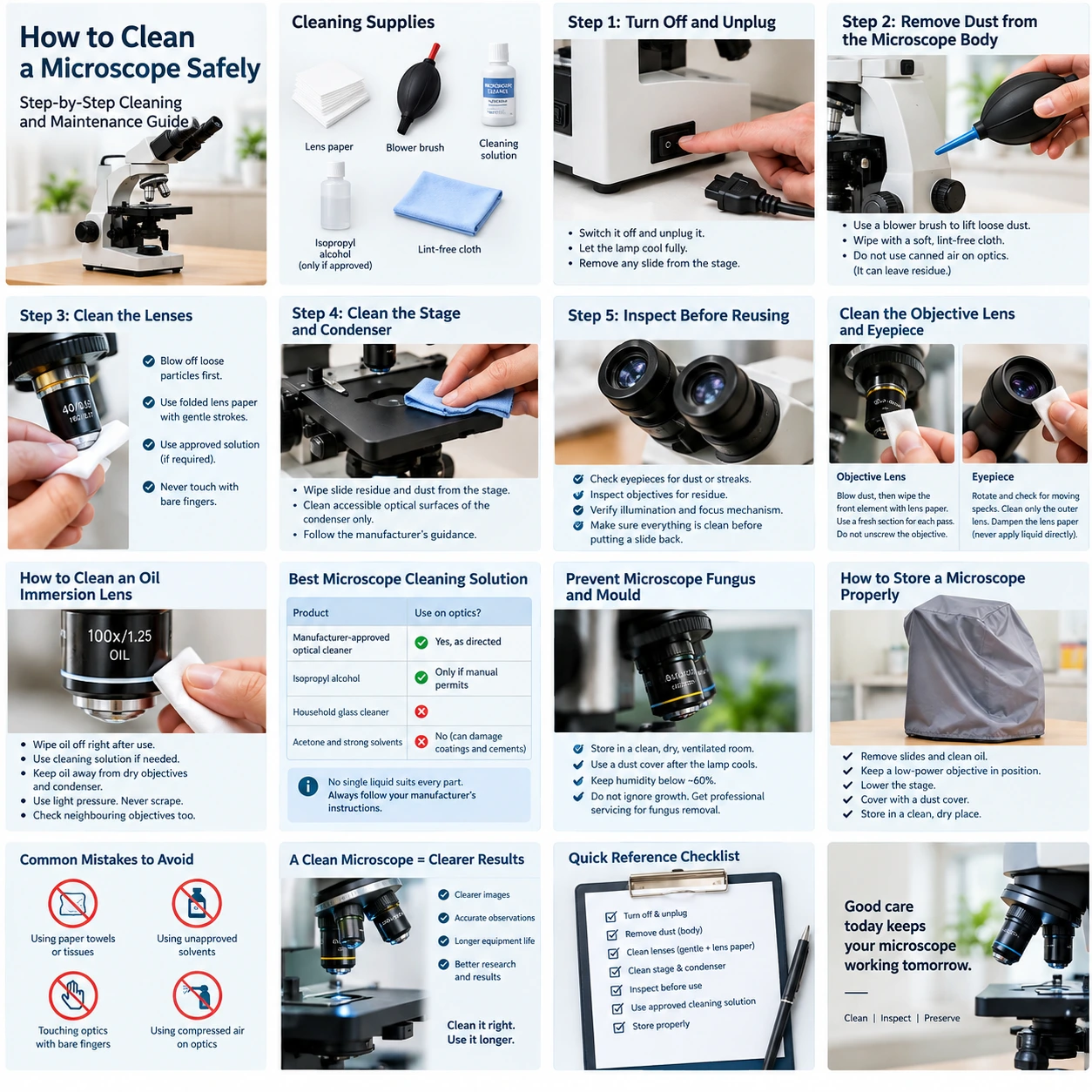
Editorial note: This guide covers general cleaning and care practices for compound and laboratory microscopes. Coatings, materials and designs differ between models, so your manufacturer’s manual always comes first if it disagrees with a step below. If you are still comparing microscope types before you buy, our microscope guide explains the main types and where each one is used.
The ALMICRO Editorial Team
How to clean a microscope comes down to three habits: remove loose dust first, wipe optics gently with lens paper, and use only cleaning products your manufacturer approves. Done right, it takes a few minutes. Done wrong, it can scratch a lens coating for good.
Dust, fingerprints and old immersion oil all blur the image. Many people then blame the microscope for what is really a dirty lens. Regular microscope maintenance protects image clarity, keeps observations accurate and extends the life of the equipment.
Each part needs its own method. A stage can take a soft cloth. A lens cannot. This guide covers every part in turn.
What Supplies Do You Need to Clean a Microscope?
Keep a small cleaning kit near the microscope so you never improvise with the wrong material.
- Lens paper: Soft, lint-free and made for delicate optical surfaces.
- Blower brush: Removes loose dust without touching the lens.
- Approved microscope cleaning solution: Use only what the manufacturer recommends.
- Isopropyl alcohol: Only if the manual approves it for that lens coating and component.
- Lint-free cloth: For the body, stage and other external surfaces.
Avoid ordinary tissues, paper towels and unapproved solvents on optical surfaces. They can scratch glass and strip coatings.
How to Clean a Microscope Step by Step
Step 1: Turn Off and Unplug the Microscope
Switch it off and unplug it. Let the lamp cool fully. Remove any slide from the stage.
Step 2: Remove Dust from the Microscope Body
Use the blower brush to lift loose dust from the body, arm and base. Then wipe suitable external surfaces with a soft, lint-free cloth. Do not use canned compressed air on optics. The propellant can leave residue.
Step 3: Clean the Lenses
- Blow off loose particles first. Wiping grit across glass causes scratches.
- Fold a fresh sheet of lens paper and use gentle strokes.
- Add an approved solution only as the manufacturer instructs.
- Never touch optical surfaces with bare fingers.
Step 4: Clean the Stage and Condenser
Wipe slide residue and dust off the stage with a suitable cloth. Clean only the accessible optical surfaces of the condenser, and follow the manufacturer’s guidance.
Step 5: Inspect Before Reusing
Check the eyepieces, objectives, illumination and focus mechanism. Look for streaks or leftover residue on the optics before you put a slide back.
How to Clean a Microscope Objective Lens and Eyepiece
Microscope Objective Lens
Look at the front lens under good light. Blow away dust, then wipe the front element once with clean lens paper. Use a fresh section for each pass. Never unscrew or open an objective to clean inside it.
Microscope Eyepiece
Not sure where the dirt is? Rotate the eyepiece while you look through it. If the speck moves, it is on the eyepiece. Clean the accessible outer lens only, and never apply liquid directly to the glass. Dampen the lens paper instead.
If contamination sits inside the optics, stop. Internal cleaning belongs with a qualified technician.
How to Clean an Oil Immersion Lens
Oil must come off after every session. Left to dry, it turns sticky, attracts dust and can seep into the objective.
- Wipe the oil off the 100x objective right after use with fresh, dry lens paper.
- If a film remains, use fresh paper with the cleaning solution the manufacturer specifies.
- Keep oil away from dry objectives and the condenser.
- Use light pressure. Never scrape.
Check neighbouring objectives too. Oil travels more easily than most people expect.
What Is the Best Microscope Cleaning Solution?
The right microscope cleaning solution depends on the lens coating, the component and the manufacturer’s instructions. No single liquid suits every part.
| Product | Use on optics? |
|---|---|
| Manufacturer-approved optical cleaner | Yes, as directed |
| Isopropyl alcohol | Only if the manual explicitly permits |
| Household glass cleaner | No |
| Acetone and strong solvents | No, can damage coatings and cements |
Microscope makers such as Nikon MicroscopyU publish educational material on optics and care that is worth reading alongside your own manual.
How to Prevent Microscope Fungus and Mould on Lenses
Warm, humid air lets fungus grow on optical surfaces. It can etch the glass if left alone.
- Store the microscope in a clean, dry, ventilated room.
- Fit a dust cover once the lamp has cooled.
- Control humidity with room conditions or a suitable dry cabinet. Keeping it below roughly 60% is a common target.
- Do not ignore established growth. Microscope fungus removal needs professional inspection and servicing.
How to Store a Microscope Properly
- Remove slides and clean off any immersion oil.
- Leave the recommended low-power objective in position.
- Lower the stage and secure moving parts as instructed.
- Cover the microscope with a dust cover.
- Keep it away from moisture, direct sunlight and heat.
Microscope Maintenance Checklist
- ☐ Inspect optics for dust and fingerprints.
- ☐ Clean immersion oil after use.
- ☐ Wipe the stage and microscope exterior.
- ☐ Check that the bulb or LED works properly.
- ☐ Test focus controls and mechanical stage movement.
- ☐ Check storage conditions and humidity.
- ☐ Lubricate the mechanical stage only if the manufacturer recommends it.
- ☐ Book annual servicing based on usage and manufacturer guidance.
FAQs About Microscope Cleaning and Maintenance
How often should you clean a microscope?
Clean visible dust, oil or smudges straight away. Otherwise, do a quick check before each session and a fuller clean on a schedule that fits how often the microscope is used and how dusty your lab is.
Can I use isopropyl alcohol to clean microscope lenses?
Only if the manufacturer approves it for that specific lens surface and coating. Some coatings are damaged by alcohol. Check the manual first, and use the approved cleaner if you are unsure.
How do you remove fungus from microscope lenses?
Established fungus usually needs professional optical servicing. Wiping it yourself can spread spores and scratch the glass. Prevention is easier: keep humidity low, store the microscope covered and inspect optics regularly.
How can I maintain a microscope for long-term performance?
Clean gently, store it dry and covered, and inspect it often. Add scheduled professional servicing for internal optics and mechanics. Small, regular habits protect the microscope far better than occasional deep cleans.
Keep Your Microscope Clean for Reliable Performance
The right supplies, gentle lens care, humidity control and steady maintenance keep a microscope sharp for years. Follow your manufacturer’s instructions, and call a technician for internal contamination or mechanical faults. Not sure which model suits your lab? Our microscope guide is a good place to start, and ALMICRO, a microscope manufacturer in India since 1978, can help from there.
Reference Blogs :
https://almicromicroscope.com/blog/microscope-types-and-diagrams