
How Does an Autoclave Work? Understanding the Step-by-Step Sterilization Process
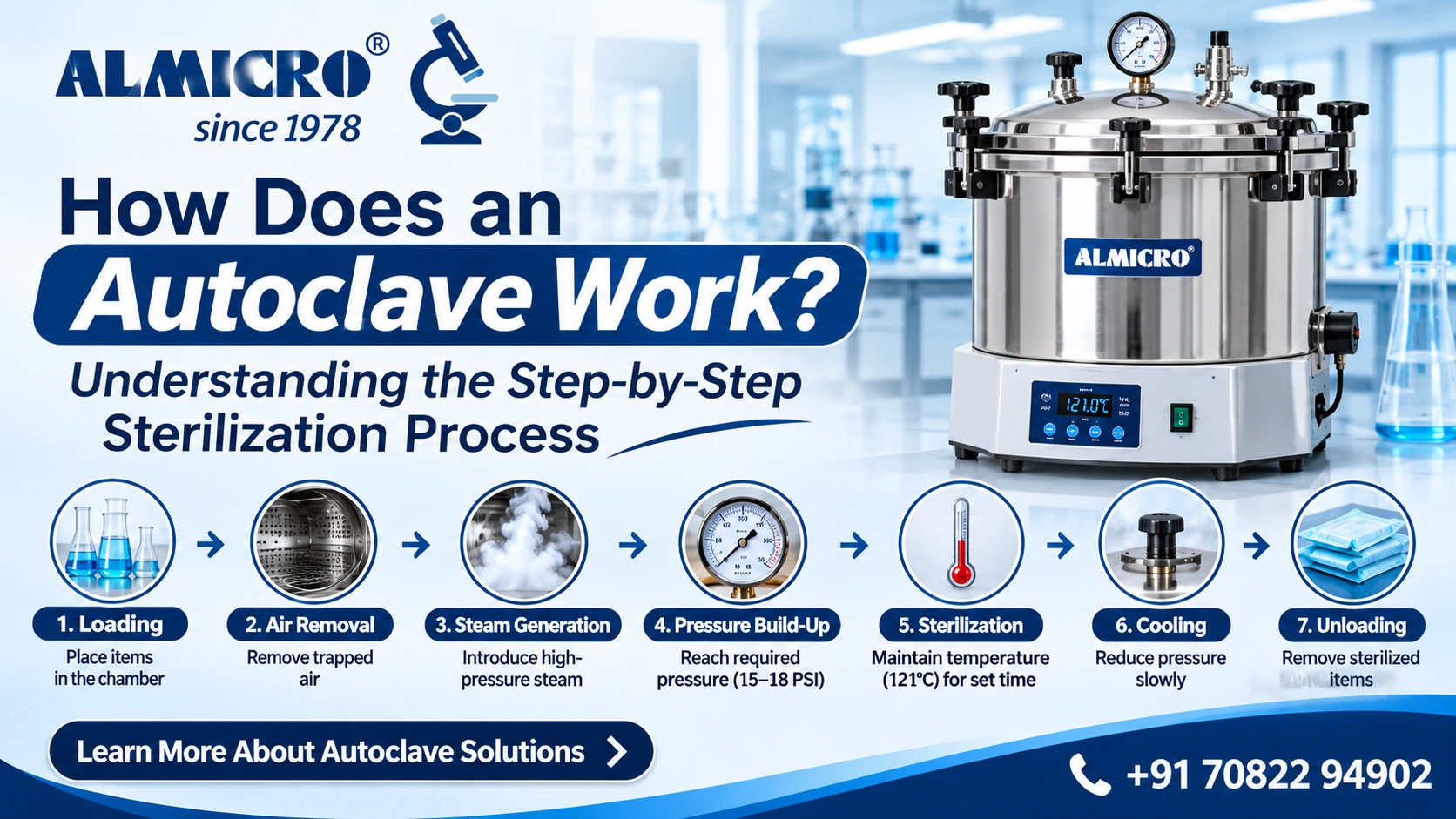
Almost everything sterile in a laboratory has been through an autoclave first. So, how does an autoclave work? It seals the load inside a pressure chamber, removes the air, fills the chamber with saturated steam and holds a set temperature for a fixed time to destroy microorganisms.
This guide explains each stage of the autoclave sterilization process in order and why every step matters.
What Is an Autoclave and Why Is It Used for Sterilization?
An autoclave is a sealed pressure vessel that sterilizes materials using steam under pressure. Increasing the pressure allows steam to reach temperatures well above 100°C. At these temperatures, moist heat destroys microorganisms more effectively than dry air.
Hospitals, laboratories, pharmaceutical plants and research centres depend on autoclaves for routine sterilization. A single cycle can sterilize instruments, glassware and culture media, helping prevent microbial contamination in experiments, clinical procedures and production environments.
This article focuses on the sterilization process itself. For a broader explanation of the autoclave working principle, applications and buying advice, refer to our related autoclave guide linked at the end of this article.
What Are the Main Components of an Autoclave?
Small benchtop autoclaves and large hospital sterilizers are built around the same essential components. Each part plays a role in controlling temperature, pressure and sterilization safety.
- Sterilization Chamber: The sealed vessel that holds the materials during the sterilization cycle.
- Heating Element: Heats water to generate steam. Larger units may use an external steam supply.
- Pressure Gauge: Displays the pressure inside the chamber.
- Temperature Sensor: Monitors the chamber temperature throughout the cycle.
- Safety Valve: Automatically releases steam if pressure exceeds the safe limit.
- Door Locking Mechanism: Keeps the door securely closed while the chamber is pressurized.
- Gasket or Sealing Ring: Creates a steam-tight seal around the chamber door.
- Steam Release Valve: Releases steam at the end of the sterilization cycle.
- Control Panel: Allows users to set and monitor cycle parameters.
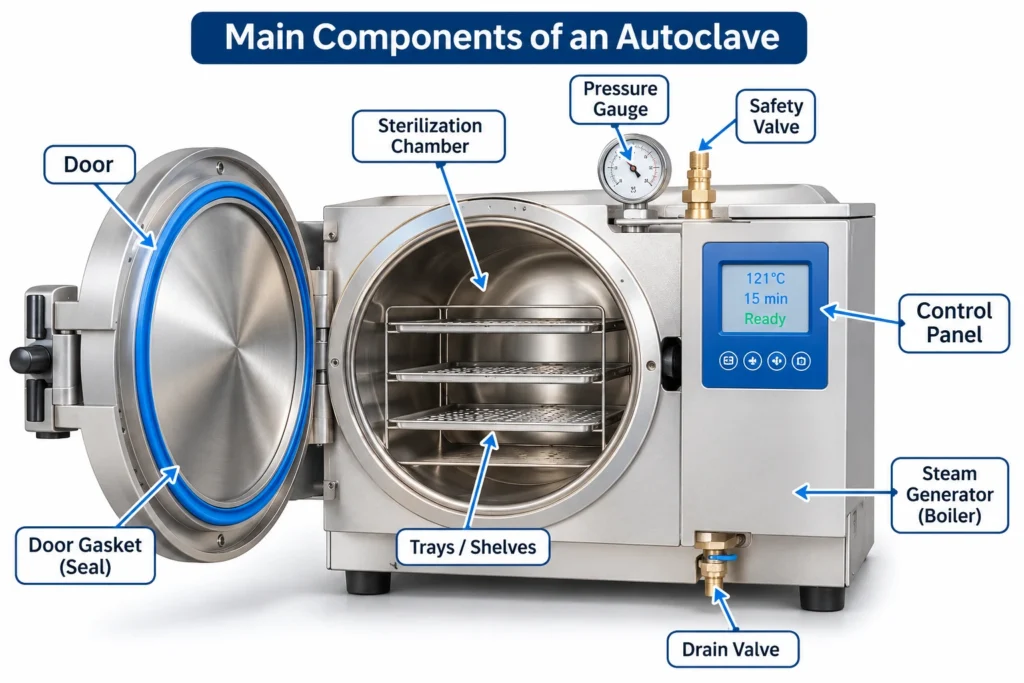
internal components of an autoclave machine
How Does an Autoclave Work? Step-by-Step Sterilization Process
A standard autoclave sterilization cycle moves through seven main stages. Every stage is important because incomplete air removal, incorrect temperature or insufficient exposure time can result in an unsterile load.
Step 1: Loading Materials into the Autoclave
First, place instruments, glassware and other compatible materials inside the sterilization chamber. Arrange them so steam can reach every surface.
- Leave enough space between items for steam circulation.
- Keep containers loosely capped or covered.
- Avoid overloading the chamber.
Overloading blocks steam circulation and creates cold spots where microorganisms may survive.
Step 2: Removing Air from the Sterilization Chamber
Trapped air acts as an insulating layer and prevents steam from reaching all surfaces. This can cause sterilization failure even when the pressure gauge displays the expected reading.
Autoclaves generally use two approaches for air removal:
- Gravity Displacement: Incoming steam pushes the heavier air out through a drain.
- Pre-Vacuum System: A vacuum pump removes air before steam enters the chamber. This is particularly useful for wrapped instruments and porous loads.
Step 3: Steam Generation and Pressure Build-Up
The heating element boils water to produce steam. As steam fills the sealed chamber, internal pressure increases. Higher pressure raises the boiling point of water, allowing the chamber to reach temperatures of 121°C or more.
This is how an autoclave reaches temperatures that ordinary boiling water cannot achieve at normal atmospheric pressure.
Step 4: Maintaining the Required Temperature
Once the required temperature is reached, the autoclave maintains it for a specific exposure time. Two common sterilization settings are:
- 121°C: Many routine loads require approximately 15–20 minutes of exposure.
- 134°C: Some suitable instrument loads require approximately 3–4 minutes of exposure.
Actual exposure time depends on the material, load size and validated sterilization cycle. Liquids and dense packs generally need longer. The temperature sensor and pressure gauge are monitored throughout the process, and the exposure timer should start only after the chamber reaches the set temperature.
Step 5: Destroying Microorganisms Through Steam Sterilization
Moist heat denatures microbial proteins and enzymes and damages cell structures. Under validated sterilization conditions, this process destroys bacteria, viruses, fungi and bacterial spores.
Bacterial spores are particularly resistant to heat. That is why the correct temperature and exposure time must be maintained throughout the cycle.
Step 6: Releasing Pressure and Cooling
After the exposure period, steam is released through the steam release valve in a controlled manner. The chamber pressure gradually returns to a safe level.
Liquids require slow pressure release because a sudden pressure drop can cause them to boil over. Allow the materials to cool before handling them.
Step 7: Removing Sterilized Materials
Open the door only after the pressure gauge reads zero. Always use heat-resistant gloves and suitable eye protection while removing materials.
Before using or storing the load:
- Check the chemical indicator on each pack.
- Review the sterilization cycle record.
- Confirm that the indicator has changed as expected.
If an indicator does not show the expected result, treat the load as non-sterile.
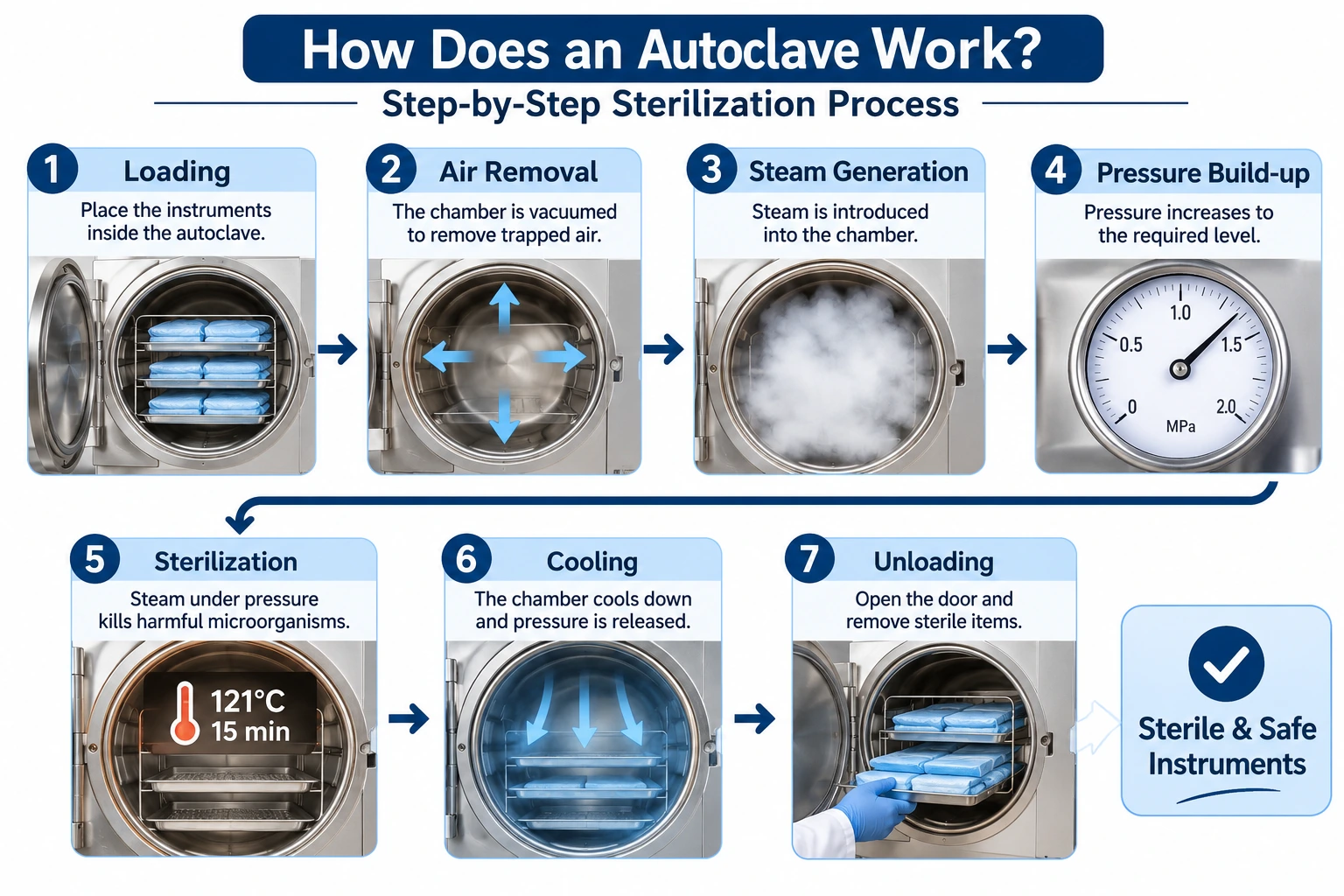
Seven stages of the autoclave sterilization process
How Do Temperature and Pressure Affect Autoclave Sterilization?
Autoclaves use saturated steam, which transfers heat efficiently when it condenses on cooler surfaces. In saturated steam, temperature and pressure increase together. Each temperature therefore corresponds to an approximate pressure.
| Temperature | Approximate Absolute Pressure |
|---|---|
| 121°C | 2.05 bar |
| 134°C | 3.04 bar |
Pressure alone does not guarantee sterilization. It allows steam to reach the required temperature. Effective sterilization depends on the combination of temperature, exposure time, steam penetration and load configuration.
A tightly packed load or one containing trapped air may remain below the target temperature even when the pressure gauge shows the expected reading.
What Materials Can Be Sterilized in an Autoclave?
Several laboratory and medical materials are generally suitable for steam sterilization, provided they are rated for the selected cycle.
- Laboratory glassware
- Stainless steel instruments
- Microbiological culture media
- Suitable surgical instruments
- Reusable laboratory supplies
- Compatible sterilization containers
What Materials Should Not Be Autoclaved?
Some materials cannot withstand high-temperature steam or are unsuitable for this sterilization method. Keep the following out of the chamber:
- Heat-sensitive plastics: May melt or become deformed.
- Flammable chemicals: Can create fire and explosion risks.
- Oils and powders: Steam cannot penetrate them effectively.
- Moisture-sensitive materials: May be damaged by steam exposure.
- Non-compatible equipment: Items not rated for high-temperature steam should not be autoclaved.
What Are the Different Types of Autoclaves?
Autoclave machines are available in different configurations to suit laboratory, clinical and industrial sterilization requirements.
1. Vertical Autoclave
A vertical autoclave is a top-loading, cylindrical unit. It is commonly used in laboratories for sterilizing glassware, culture media and medium-sized loads.
2. Horizontal Autoclave
A horizontal autoclave has a front-loading design and a larger chamber. Hospitals and larger facilities use these units for high-volume sterilization requirements.
3. Portable Autoclave
Portable autoclaves are compact units designed for smaller sterilization requirements and locations where available space is limited.
4. Tabletop Autoclave
Tabletop autoclaves are space-saving benchtop units suitable for clinics and smaller laboratories.
Where Are Autoclaves Commonly Used?
Autoclaves are used wherever reusable equipment, instruments or culture media need reliable sterilization. Common application areas include:
- Hospitals and healthcare facilities
- Medical and diagnostic laboratories
- Microbiology laboratories
- Pharmaceutical industries
- Biotechnology research centres
- Educational institutions
What Are the Common Mistakes to Avoid When Using an Autoclave?
Incorrect loading and cycle settings can affect sterilization results. Avoid these common mistakes:
- Overloading the sterilization chamber and blocking steam circulation.
- Using an incorrect temperature or exposure time.
- Ignoring trapped air inside the chamber.
- Using packaging that steam cannot penetrate.
- Opening the door before pressure is fully released.
- Skipping regular maintenance of gaskets and valves.
- Ignoring sterilization indicators and cycle records.
How to Choose the Right Autoclave for Your Laboratory?
The right autoclave depends on the materials you sterilize and the volume of work your laboratory handles. Evaluate these points before purchasing:
- Chamber Capacity: Match the chamber size to your daily sterilization load.
- Material Compatibility: Check whether you need to sterilize glassware, culture media, wrapped instruments or liquids.
- Temperature and Pressure: Confirm that the unit supports your required validated cycles.
- Operating System: Choose between automatic and manual operation based on your workflow.
- Safety Features: Review the available safety mechanisms and control systems.
- Maintenance and Support: Consider servicing requirements and after-sales assistance.
Choosing an autoclave according to your sterilization requirements, rather than price alone, helps avoid an undersized chamber or unsuitable cycle configuration.
ALMICRO Instruments is a laboratory equipment manufacturer and supplier with more than 700 products. Its equipment serves medical colleges, diagnostic laboratories, research institutes and pharmaceutical companies.
Explore laboratory equipment from ALMICRO Instruments.
Frequently Asked Questions About Autoclaves
How does an autoclave kill bacteria and bacterial spores?
An autoclave exposes materials to saturated steam at 121°C or higher under pressure. Moist heat irreversibly damages microbial proteins and cell structures. Bacterial spores are more heat-resistant, so the exposure time must be sufficient to destroy them.
How long does an autoclave sterilization cycle take?
The exposure time is commonly around 15–20 minutes at 121°C or 3–4 minutes at 134°C for suitable loads. The complete cycle takes longer, often 30 minutes to over an hour, because air removal, heating and cooling also take time. Liquids and larger loads may require longer cycles.
Why is pressure important in an autoclave?
Pressure raises the boiling point of water, allowing steam to reach temperatures such as 121°C or 134°C. At normal atmospheric pressure, water boils at approximately 100°C. Pressure enables the higher temperature; the moist heat is what destroys microorganisms.
What is the standard temperature for autoclave sterilization?
Many laboratory loads use 121°C, at approximately 15 psi gauge pressure (about 2.05 bar absolute). Some suitable instrument cycles use 134°C at approximately 3.04 bar absolute. The correct setting depends on the load and validated cycle.
Can all laboratory equipment be sterilized in an autoclave?
No. Heat-sensitive plastics, flammable chemicals, oils, powders and moisture-sensitive materials are generally unsuitable. Equipment must be rated for high-temperature steam exposure. Always follow the manufacturer’s instructions for each item.
What is the difference between an autoclave and a dry heat sterilizer?
An autoclave uses pressurized steam, commonly at 121°C to 134°C, for sterilization. A dry heat sterilizer, also called a hot air oven, uses hot air at approximately 160°C to 180°C for longer periods, often 30 minutes to 2 hours. Dry heat is suitable for certain materials that steam cannot treat, such as oils and powders.
Related Reference Blog
Want to understand the broader working principle, applications and types of autoclaves? Read our detailed guide for additional information about autoclave selection and laboratory sterilization.
Recommended Reading