


Description
Technical Specification Table
| Specification | Details |
|---|---|
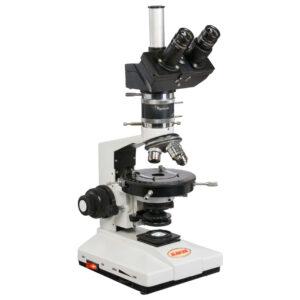
| Model | PM-11 Binocular Polarising Microscope |
| Nosepiece | Triple revolving nosepiece |
| Stage | Circular, rotatable 360°, graduated with vernier reading 0.1°, with dual centering knobs |
| Polarizing System | Swing-out polarizer, compact analyzer head with iris diaphragm, Bertrand lens, rotatable analyzer ring, half/full-wave compensator |
| Eyepieces | 5x, 10x, 15x (with cross) |
| Objectives | 5x, 10x, 45x |
| Illumination | Built-in suitable illumination (standard for polarising microscopes) |
| Focusing System | Coaxial coarse and fine focusing |
| Applications | Material science, geology, metallurgical, educational laboratories |
Key Features
-
Triple revolving nosepiece for convenient objective switching
-
Circular stage with 360° rotation and vernier scale (0.1°) for precise measurement
-
Dual stage centering knobs for accurate sample alignment
-
Swing-out polarizer and compact analyzer head with iris diaphragm
-
Bertrand lens included for conoscopic observation
-
Rotatable analyzer ring and half/full-wave compensator for advanced polarimetric studies
-
Eyepieces: 5x, 10x, and 15x with cross for enhanced field observation
-
Objectives: 5x, 10x, 45x for sharp and detailed imaging
-
Compact and sturdy design for laboratory and educational environments
-
Ideal for mineralogical, metallurgical, and material science research
Working Principle
The PM-11 Microscope functions by illuminating specimens through a polarizer and focusing light using high-quality objectives. The circular stage allows rotation of the sample to observe optical properties at different orientations, with precise vernier readings. The swing-out polarizer and rotatable analyzer ring facilitate polarized light studies. The Bertrand lens allows conoscopic observation, while half and full-wave compensators measure birefringence and retardation. Coarse and fine focusing ensures sharp, high-contrast imaging. The combination of polarizing optics and precise mechanical controls allows accurate analysis of mineralogical, metallurgical, and crystalline structures.
Applications / Use Cases
-
Geological laboratories for mineral analysis
-
Metallurgical labs for microstructure studies
-
Material science research for optical property measurement
-
Educational institutions for teaching polarizing microscopy
-
Crystallography and birefringence studies
-
Quality control in industrial laboratories
Reviews
There are no reviews yet.