

Description
Technical Specification Table
| Specification | Details |
|---|---|
| Purpose | Measurement of linear expansion of metals |
| Heating Method | Steam through nickel-plated brass tube |
| Tube Features | Well lagged, with inlet, outlet, and thermometer tubules |
| Rod Support | Detachable conical cups at each end |
| Base | Heavy-gauge channel base |
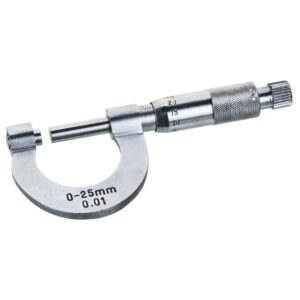
| Micrometer | Reads to 0.01 mm |
| Adjustment | Screw at one end for alignment |
| Rod Material | Copper, brass, and iron rods included |
| Rod Dimensions | Length 500 mm, Diameter 4.5 mm |
| Thermometer | Not included, available separately |
Key Features
• Measures linear expansion of metal rods
• Nickel-plated brass steam tube for uniform heating
• Well-lagged body to minimize heat loss
• Three tubules for steam inlet, outlet, and thermometer placement
• Rod supported by detachable conical cups at both ends
• Heavy-gauge channel base for strong support
• Micrometer screw with 0.01 mm precision
• Adjustable end screw for correct alignment
• Includes copper, brass, and iron rods
• Ideal for physics labs and material science experiments
• Thermometer can be added separately
Working Principle
The Linear Expansion Apparatus works by heating a metal rod with steam inside the brass tube. As the rod gains heat, it expands. This increase in length pushes against the micrometer screw at the far end. Users measure this change using the micrometer, which shows small variations in length with high precision. By recording the temperature change and the expansion value, users can calculate the coefficient of linear expansion for the metal rod.
Use Cases
• Physics laboratory experiments
• Material science demonstrations
• Thermal expansion studies in schools and colleges
• Research on heat effects in metals
Reviews
There are no reviews yet.