
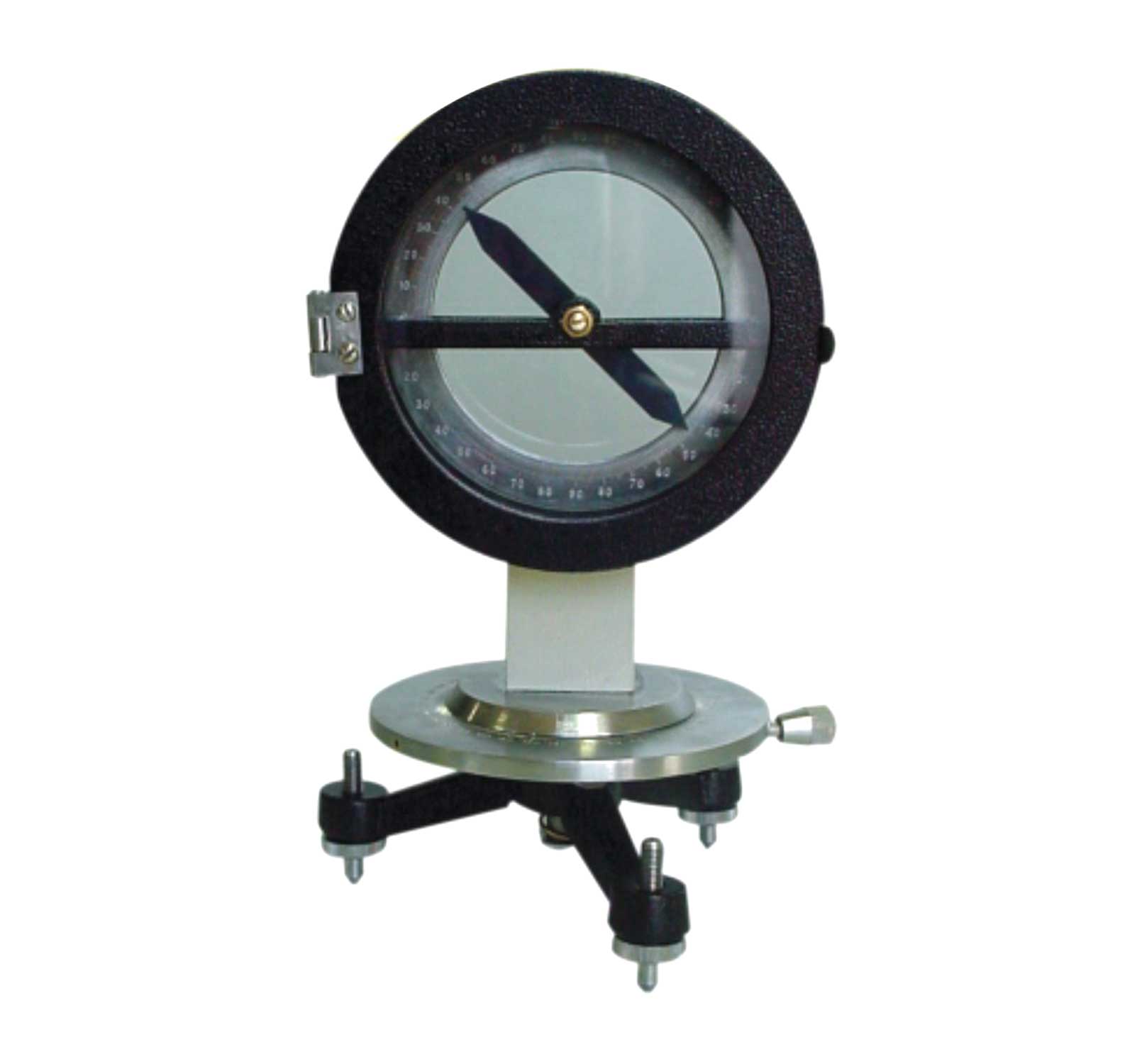
Description
Technical Specification Table
| Specification | Details |
|---|---|
| Magnetic Needle | Balanced needle made of cobalt steel |
| Pivot System | Hardened steel pivots working in agate cup bearings |
| Inclination Scale | Four quadrants, 0-90-0-90 degrees, 1-degree graduation |
| Needle Removal | Easy removal and replacement without pivot damage |
| Casing Material | Non-magnetic aluminum with glass window |
| Rotation | Needle and scale rotate vertically about a central axis |
| Horizontal Scale | 0-360 degrees, clockwise, 10-degree graduation |
| Spirit Level | Circular level fixed on the scale face |
| Base | Heavy brass tripod |
| Leveling | Three adjustable leveling screws |
Key Features
• Accurately balanced magnetic needle for stable readings
• High-strength cobalt steel needle with a strong magnetic field
• Hardened steel pivots with agate cup bearings for smooth movement
• Reversible needle design without risk of pivot damage
• Circular inclination scale divided into four quadrants for clear visibility
• Non-magnetic aluminum casing that protects internal parts
• Glass viewing window for easy observation of needle motion
• Full 360-degree horizontal rotation with a readable circular scale
• Circular spirit level for correct positioning
• Heavy brass tripod base for high stability
• Adjustable leveling screws for quick and precise setup
• Ideal for laboratory use, education, and field magnetic studies
Working Principle
A Dip Circle works by allowing a magnetic needle to rotate freely in a vertical plane. When users place the instrument in the magnetic meridian of the Earth, the needle aligns itself with the Earth’s magnetic field. The angle formed between the needle and the horizontal plane is the dip angle. Users read this angle directly from the circular scale. The stable base and spirit level help keep the instrument aligned for accurate measurement.
Use Cases
• Physics and earth science laboratories
• Universities and colleges for demonstration and training
• Geological and magnetic field surveys
• Research centers studying Earth’s magnetic behavior
• Calibration and educational experiments
Reviews
There are no reviews yet.