
Description
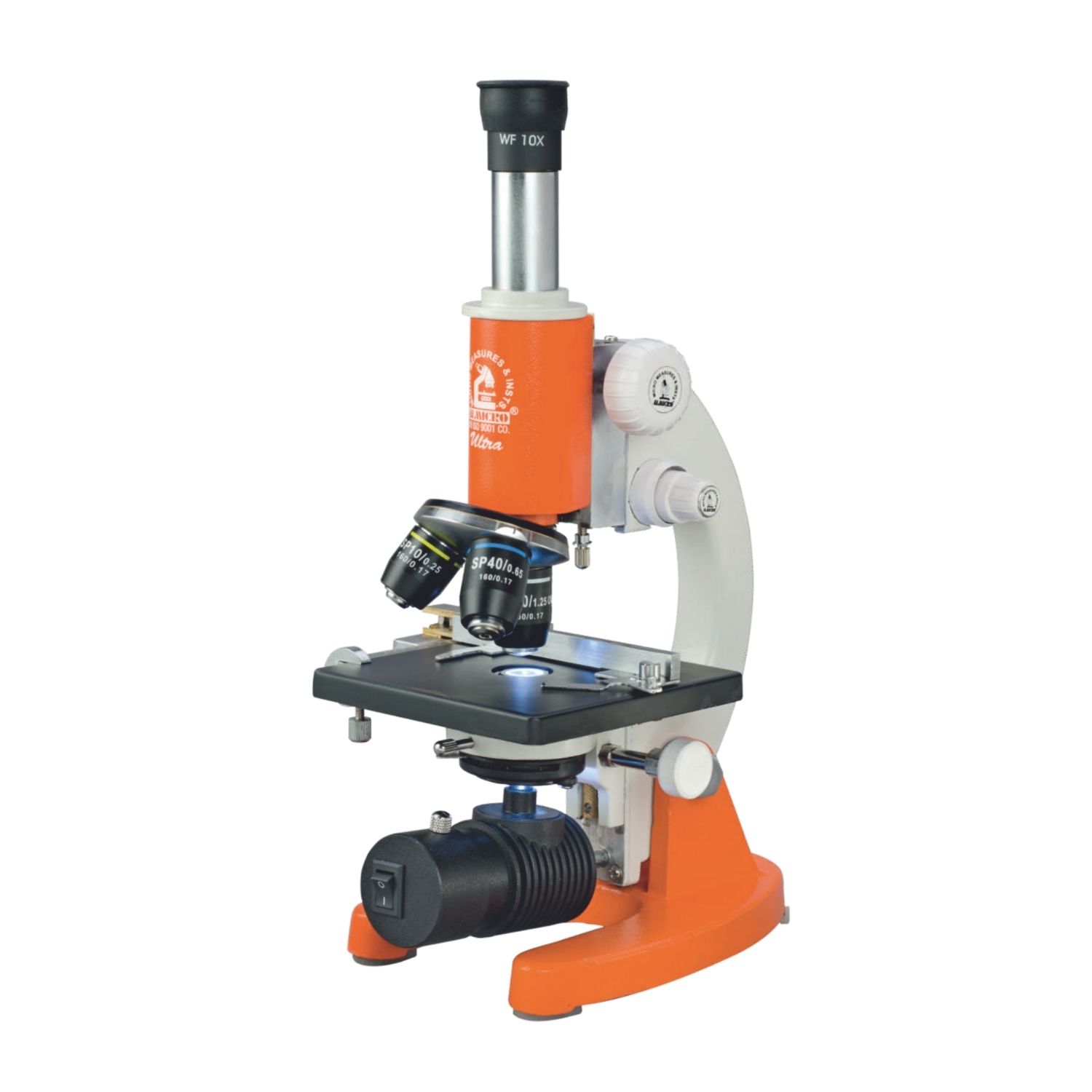
Technical Specifications – BM-5 Microscope
| Specification | Description |
|---|---|
| Observation System | Mechanical tube with 160 mm optical length and triple objective nosepiece |
| Focusing Mechanism | Independent coarse and fine focus controls |
| Stage Type | Removable horizontal mechanical stage |
| Stage Size | 120 mm × 120 mm with smooth slide control |
| Condenser | Bright-field Abbe condenser with double lens, NA 1.25 |
| Condenser Features | Fixed sub-stage mounting with iris diaphragm and swing-out filter slot |
| Slide Safety | Adjustable lower limit stopper to avoid slide breakage |
| Illumination Source | Plano-concave mirror for reflected light illumination |
Key Highlights of BM-5 Microscope
-
Mechanical observation tube with 160 mm tube length and three-position nosepiece
-
Dual focusing system allows accurate and controlled image sharpening
-
Detachable mechanical stage supports smooth and precise slide movement
-
Ergonomic stage controls ensure easy specimen positioning
-
High-quality NA 1.25 Abbe condenser delivers clear and well-defined images
-
Built-in iris diaphragm helps regulate light intensity and contrast
-
Swing-out filter holder for enhanced observation flexibility
-
Adjustable downward motion stopper protects slides from accidental damage
-
Mirror-based illumination provides uniform and reliable brightness
-
Strong and durable construction suitable for regular laboratory use
-
Ideal choice for students, technicians, and laboratory professionals
Working Principle of BM-5 Microscope
The BM-5 microscope functions by directing reflected light from a plano-concave mirror upward through the specimen. This light is evenly focused onto the sample using a bright-field Abbe condenser. The objective lenses magnify the specimen image, which is further enlarged by the eyepiece for detailed observation. Fine and coarse focusing knobs allow precise image adjustment, while the mechanical stage enables accurate slide movement. Light intensity and contrast are controlled using the iris diaphragm and optional filters.
Applications & Use Areas
-
Medical laboratories for routine cell and tissue analysis
-
Colleges and universities for academic teaching and demonstrations
-
Research laboratories for biological and microbiological studies
-
Hospital labs for diagnostic slide examination
-
Training institutes for hands-on microscopy practice
Reviews
There are no reviews yet.