
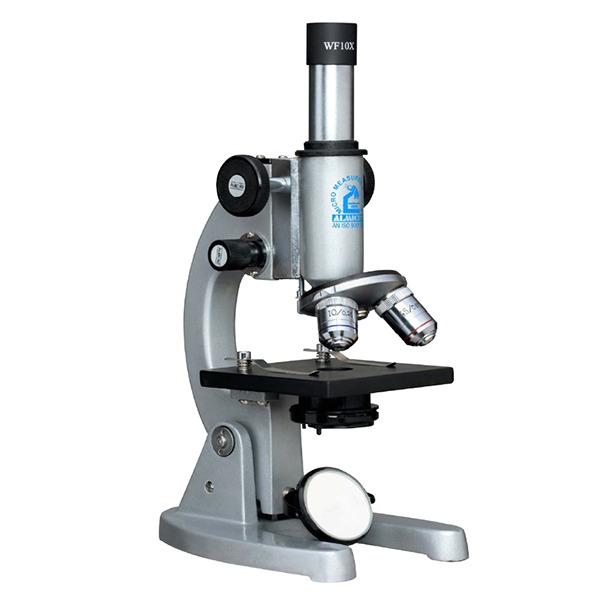
Description
Technical Specifications – Compound Student Microscope (BM–3A)
| Specification | Details |
|---|---|
| Eyepieces | Wide-field 10X or set of 10X & 15X Huygenian eyepieces |
| Objectives | Achromatic 10X and 40X/45X |
| Nosepiece | Triple revolving nosepiece with click stops |
| Stage | Stainless steel stage clips |
| Focusing | Coarse (rack-and-pinion) + fine focusing (screw lever mechanism) |
| Condenser | Abbe condenser NA 1.25 with iris diaphragm & swing-out filter holder |
| Illuminator | Arc reflector for natural light |
| Packing | Styrofoam box or wooden cabinet with lock (optional) |
| Accessories | Vinyl dust cover, operating manual |
| Use Case | Classroom training, slide analysis, student practical learning |
Key Features
-
Wide-field 10X eyepiece or set of 10X & 15X Huygenian eyepieces
-
Triple revolving nosepiece with positive click stops
-
Achromatic objectives 10X and 40X/45X for clear, accurate imaging
-
Smooth rack-and-pinion coarse focusing with fine screw lever adjustment
-
Abbe condenser NA 1.25 with iris diaphragm for optimal illumination control
-
Swing-out filter holder for improved contrast and clarity
-
Arc reflector for bright natural light observation
-
Sturdy stage with stainless steel clips to securely hold the slide
-
Durable construction suited for continuous classroom use
-
Safe packing in molded Styrofoam or optional wooden cabinet
-
Includes dust cover and operating manual
Working Principle
The BM–3A operates on the transmitted light microscopy principle, where light passes through the specimen to form a magnified image.
The arc reflector provides natural illumination, which is collected and concentrated by the Abbe condenser. The iris diaphragm allows control over brightness and contrast, ensuring optimal viewing conditions for different samples.
Light then travels through the achromatic objective lens, where the major magnification occurs. These lenses minimize distortion and color fringing, producing clear and accurate images.
The magnified image is further enlarged through the eyepiece, giving students a bright and detailed view of cellular structures and microorganisms.
The focusing system includes both coarse and fine adjustments. The rack-and-pinion mechanism supports large vertical movements for quick focusing, while the screw lever mechanism allows precise fine adjustments—important for viewing delicate slide details.
This combination delivers smooth, accurate focus control, making it suitable for beginners and advanced learners alike.
Use Cases
-
School and college biology labs
-
Basic microscopy training for students
-
Study of plant and animal tissues
-
Observation of microorganisms and prepared slides
-
Hands-on learning for science projects and practical exams
Reviews
There are no reviews yet.