
Description
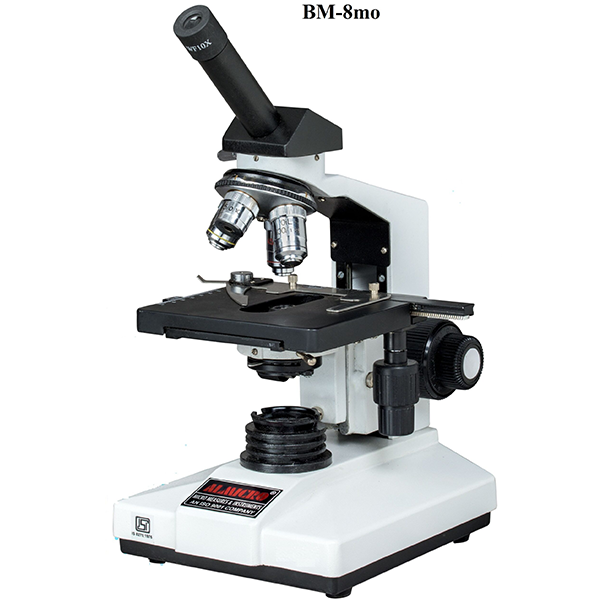
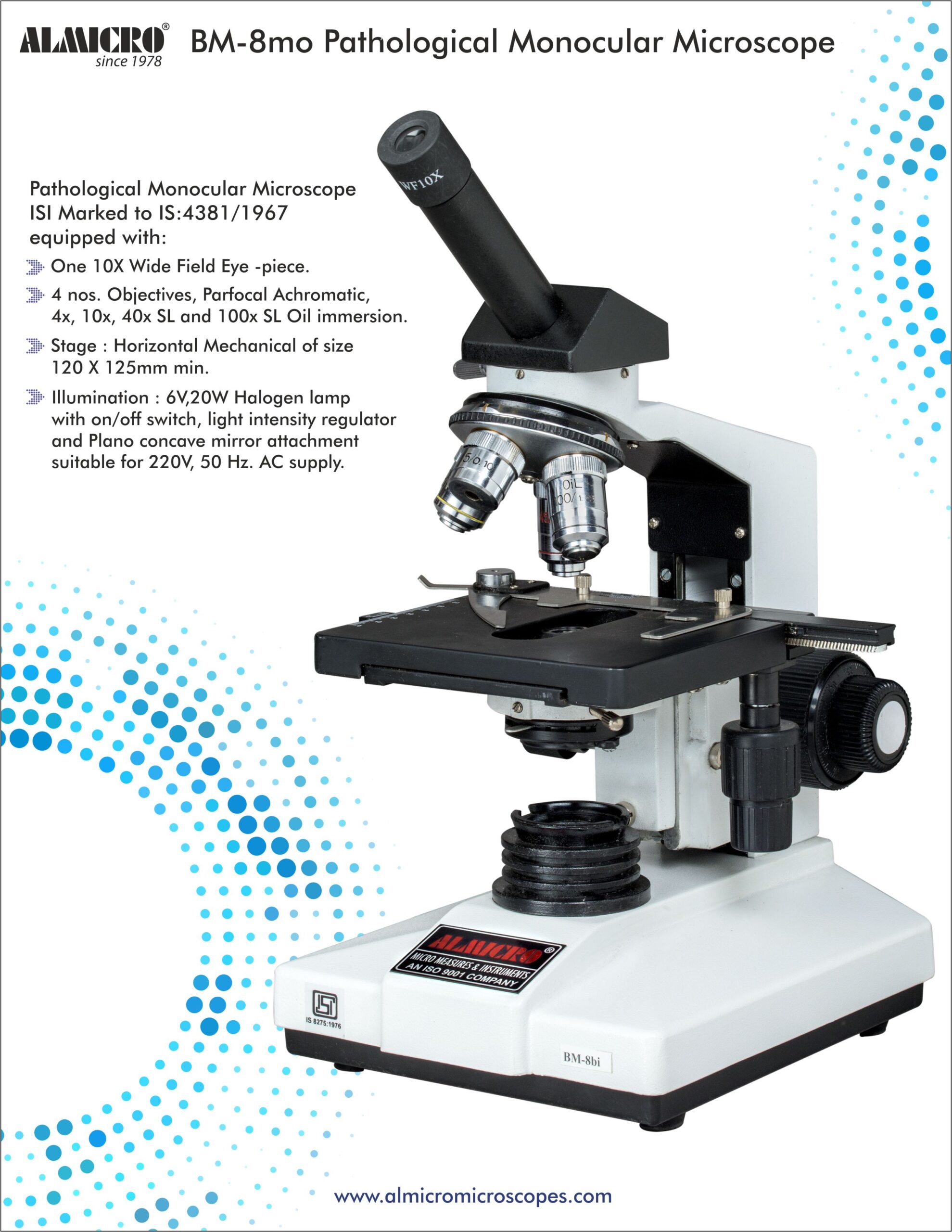
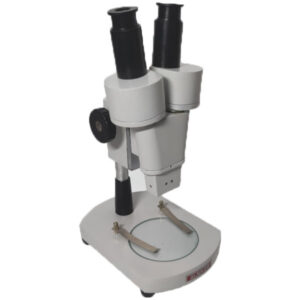
BM–8MO Microscope – Technical Specifications & Features
Technical Specifications
| Specification | Details |
|---|---|
| Head Type | Inclined monocular head for ergonomic viewing |
| Eyepiece | 10X wide-field for comfortable observation |
| Objectives | Parfocal achromatic: 4x, 10x, 40x SL, 100x SL oil immersion |
| Stage | Horizontal mechanical stage, minimum 120 x 125 mm for smooth slide movement |
| Illumination | 6V, 20W halogen lamp with on/off switch and adjustable light intensity |
| Mirror | Plano-concave mirror attachment for supplementary illumination |
| Standards | ISI-marked as per IS: 4381/1967 |
| Supply | 220V, 50Hz AC |
Key Features
-
Ergonomic inclined monocular head paired with a 10X wide-field eyepiece for strain-free viewing.
-
Parfocal achromatic objectives (4x, 10x, 40x SL, 100x SL oil immersion) for sharp and accurate magnification.
-
Horizontal mechanical stage (120 x 125 mm minimum) ensures precise slide handling and positioning.
-
6V, 20W halogen illumination with an on/off switch and dimmer for controlled lighting.
-
Optional plano-concave mirror for extra light in low-light conditions.
-
Compliant with ISI standards (IS: 4381/1967), ensuring reliability and quality.
-
Robust design suitable for clinical, educational, and research environments.
-
Produces bright, high-resolution images ideal for laboratory analysis and pathology.
Working Principle
The BM–8MO microscope operates by directing light from the halogen lamp or the plano-concave mirror onto the specimen. The light passes through the condenser and the selected objective lens to magnify the sample. Observation is performed via the 10X wide-field eyepiece. Fine and coarse focus knobs allow precise focusing, while the horizontal mechanical stage ensures smooth slide movement. The combination of parfocal objectives and adjustable illumination delivers clear, detailed, and sharp images, making it ideal for pathology, clinical, and research applications.
Applications / Use Cases
-
Pathology Labs: Examination of tissues and cells.
-
Clinical Labs: Routine diagnostic testing.
-
Educational Institutions: Teaching and practical demonstrations in colleges and universities.
-
Research Facilities: Microscopic studies and experimental analysis.
-
Reviews
There are no reviews yet.