Description
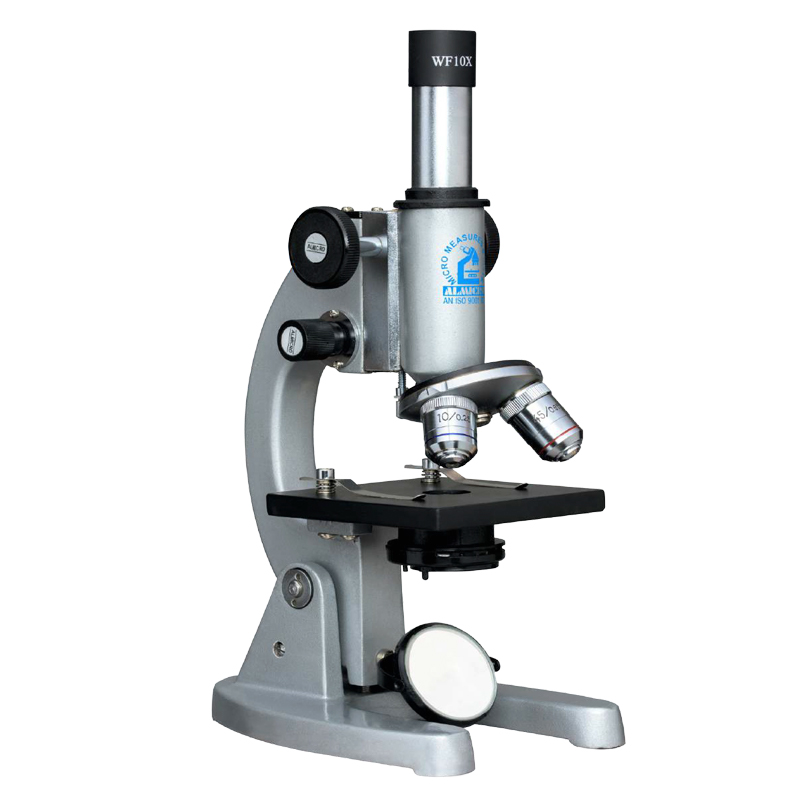
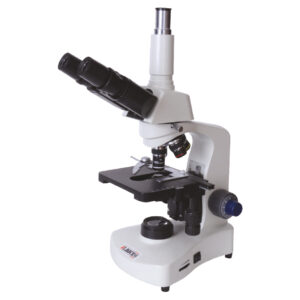
BM–3A Compound Student Microscope – Technical Specifications & Features
Technical Specifications
| Specification | Details |
|---|---|
| Model | BM-3A Compound Student Microscope |
| Body Type | Heavy-duty die-cast monocular body |
| Head Inclination | Inclinable up to 90° for ergonomic viewing |
| Eyepiece | Wide-field 10X (optional 10X & 15X Huygenian) |
| Nosepiece | Triple revolving nosepiece with click stops |
| Objectives | Achromatic 10X and 40X/45X |
| Focusing System | Vertical movement tube with rack & pinion coarse focus and fine motion screw |
| Stage | Stainless steel stage with clips for secure slides |
| Condenser | Abbe condenser N.A. 0.125 with iris diaphragm and swing-out filter holder |
| Illumination | Arc-reflector system for natural light |
| Packaging | Thermocol/styrofoam inner packing with cardboard box |
Key Features
-
Heavy-duty die-cast body ensures long-lasting durability.
-
Head inclinable up to 90° for comfortable student use.
-
Wide-field eyepiece provides clear and strain-free viewing.
-
Triple revolving nosepiece with positive click stops for easy objective switching.
-
Achromatic objectives deliver sharp, distortion-free images.
-
Smooth rack & pinion coarse focus with fine motion screw for precise adjustments.
-
Stainless steel stage with clips keeps slides securely in place.
-
Abbe condenser with iris diaphragm provides controlled illumination.
-
Arc-reflector system allows bright natural light observation.
-
Perfectly suited for school and college laboratories.
Working Principle
The BM-3A Microscope functions by directing light from the arc-reflector onto the specimen on the stage. The Abbe condenser focuses light uniformly through the sample, while achromatic objectives magnify the image. The eyepiece further enlarges the view for observation. Coarse and fine focusing mechanisms allow precise image adjustment, giving students a clear and detailed view of biological samples for learning and practical exercises.
Applications / Use Areas
-
School laboratories for basic biology experiments.
-
College labs for introductory microscopy training.
-
Educational institutions for student demonstrations.
-
Training centers for practical microscopy learning.
-
Routine lab observations for teaching purposes.
Reviews
There are no reviews yet.