
Description
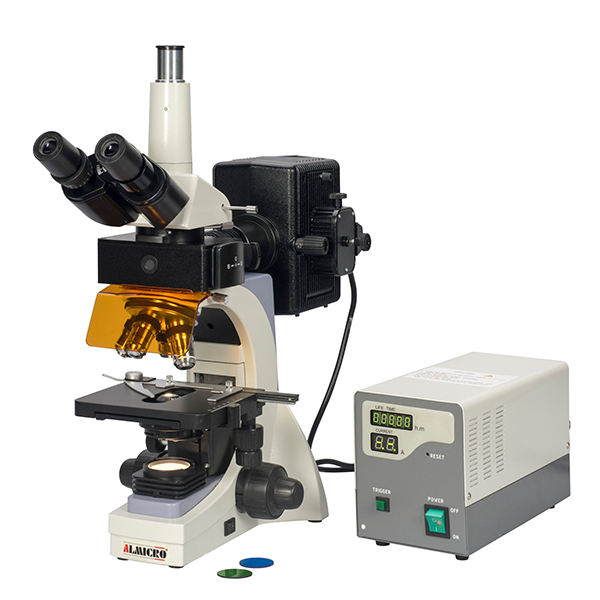
AFM-100 Fluorescent Microscope – Technical Specifications & Features
Technical Specifications
| Specification | Details |
|---|---|
| Model | AFM-100 |
| Viewing Head | Compensation-free trinocular, 30° inclined |
| Interpupillary Distance | 48–75 mm |
| Eyepiece | EW 10X / 20 mm wide-field |
| Nosepiece | Inverse quadruple |
| Objectives | 4X/0.10, 10X/0.25, 20X/0.65, 40X/1.25 (fluorescent) |
| Optical System | Infinite plan achromatic |
| Stage | Double-layer mechanical stage, 210 × 140 mm, travel 75 × 50 mm |
| Focusing | Coaxial coarse and fine, 2 µm minimum fine adjustment |
| Transmitted Light Source | 6V / 20W halogen lamp |
| Fluorescence Lamp | 100W HBO mercury lamp |
| Filters | Blue, green, UV, frosted glass |
| Power Supply | AC 220V |
| Centering Telescope | 30 mm |
| Immersion Oil | Included |
| Safety | UV protection barrier |
Key Features
-
Delivers high-resolution fluorescent imaging for detailed observation.
-
Infinite optical system ensures sharp, bright, and distortion-free images.
-
Wide-field EW 10X/20 mm eyepiece for clear visualization.
-
Trinocular head inclined at 30° allows comfortable viewing and camera attachment.
-
Plan achromatic objectives with long working distance for precise focusing.
-
Blue, green, and UV excitation filters for versatile fluorescence applications.
-
Inverse quadruple nosepiece enables rapid objective changes.
-
Coaxial coarse and fine focusing system with 2 µm precision for accurate positioning.
-
Double-layer mechanical stage (210 × 140 mm) with 75 × 50 mm travel for stable slide handling.
-
Halogen lamp (6V/20W) for transmitted light observation.
-
100W HBO mercury lamp for bright fluorescence excitation.
-
UV protection barrier ensures user safety.
-
Sturdy, reliable frame for extended laboratory use.
Working Principle
The AFM-100 Fluorescent Microscope works by directing light from the mercury lamp through the selected excitation filters onto the specimen. Fluorescent dyes in the sample absorb this light and emit visible fluorescence, which passes through barrier filters before reaching the eyepiece or camera port. The infinite optical system produces bright, clear, and sharp fluorescent images. The mechanical stage and fine focusing allow precise positioning and optimal focus for accurate observation and imaging.
Applications / Use Cases
-
Cell culture research and monitoring of live samples.
-
Fluorescent staining in microbiology and immunology studies.
-
Clinical diagnostics in pathology and immunology labs.
-
Research laboratories using blue, green, or UV fluorescence techniques.
-
Identification of viruses, bacteria, and microorganisms.
-
Medical and educational institutions for teaching and practical demonstrations.
Reviews
There are no reviews yet.