


Description
Technical Specification Table
| Specification | Details |
|---|---|
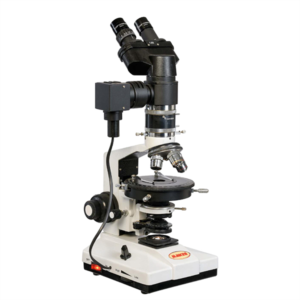
| Microscope Type | Ore Microscope with Incident & Transmitted Light |
| Observation Heads | Binocular (replaceable with Monocular / Trinocular) |
| Illumination | Incident & Transmitted illumination |
| Light Source | Built-in 6V / 20W halogen lamp |
| Light Control | Solid-state light intensity control |
| Stage | Rotatable stage, 0–360° graduated with vernier |
| Condenser | Adjustable condenser, N.A. 1.25 |
| Polarizer | Graduated polarizer with in-out system |
| Analyzer | Sliding analyzer |
| Compensators | 1/2 wave & 1/4 wave compensators |
| Bertrand Lens | Provided |
| Eyepieces | 5X (cross), 10X (ocular), 15X (optional) |
| Objectives | P5X, P10X, P40X / 45X |
Key Features
-
Designed for ore microscopy using incident and transmitted light
-
Interchangeable binocular, monocular, and trinocular observation heads
-
Precision rotatable stage graduated 0–360° with vernier scale
-
Built-in halogen illumination (6V 20W) for consistent brightness
-
Solid-state light intensity control for stable illumination
-
Adjustable condenser with N.A. 1.25 for optimal light focusing
-
Graduated polarizer with smooth in-out mechanism
-
Sliding analyzer for advanced polarization studies
-
Bertrand lens for conoscopic observation
-
Supplied with 1/2 wave and 1/4 wave compensators
-
Paired eyepieces including cross eyepiece for polarization work
-
Polarizing objectives suitable for ore analysis
-
Rugged construction for laboratory and academic use
Working Principle
The Ore Microscope operates by illuminating mineral specimens using either reflected (incident) or transmitted light, depending on the sample type. Light from the halogen source is regulated through solid-state control and directed through the polarizer and condenser. The specimen is placed on a precision rotatable stage, allowing angular measurement and orientation analysis.
Polarizing components such as the analyzer, compensators, and Bertrand lens modify light behavior to reveal optical properties like bireflectance, anisotropy, and internal structure. The objectives magnify the image, which is further observed through the eyepieces, enabling accurate mineral identification and structural interpretation.
Applications / Use Cases
-
Ore mineral identification in geology laboratories
-
Mineralogical and petrographic research
-
Metallurgical analysis of polished ore sections
-
Teaching polarization and ore microscopy in universities
-
Mining and exploration laboratories
-
Research institutes studying mineral textures
-
Industrial material and metallurgical inspection
Reviews
There are no reviews yet.