
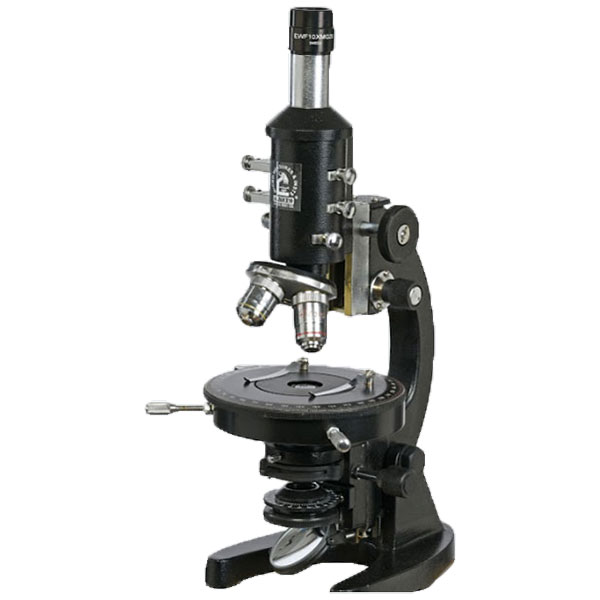
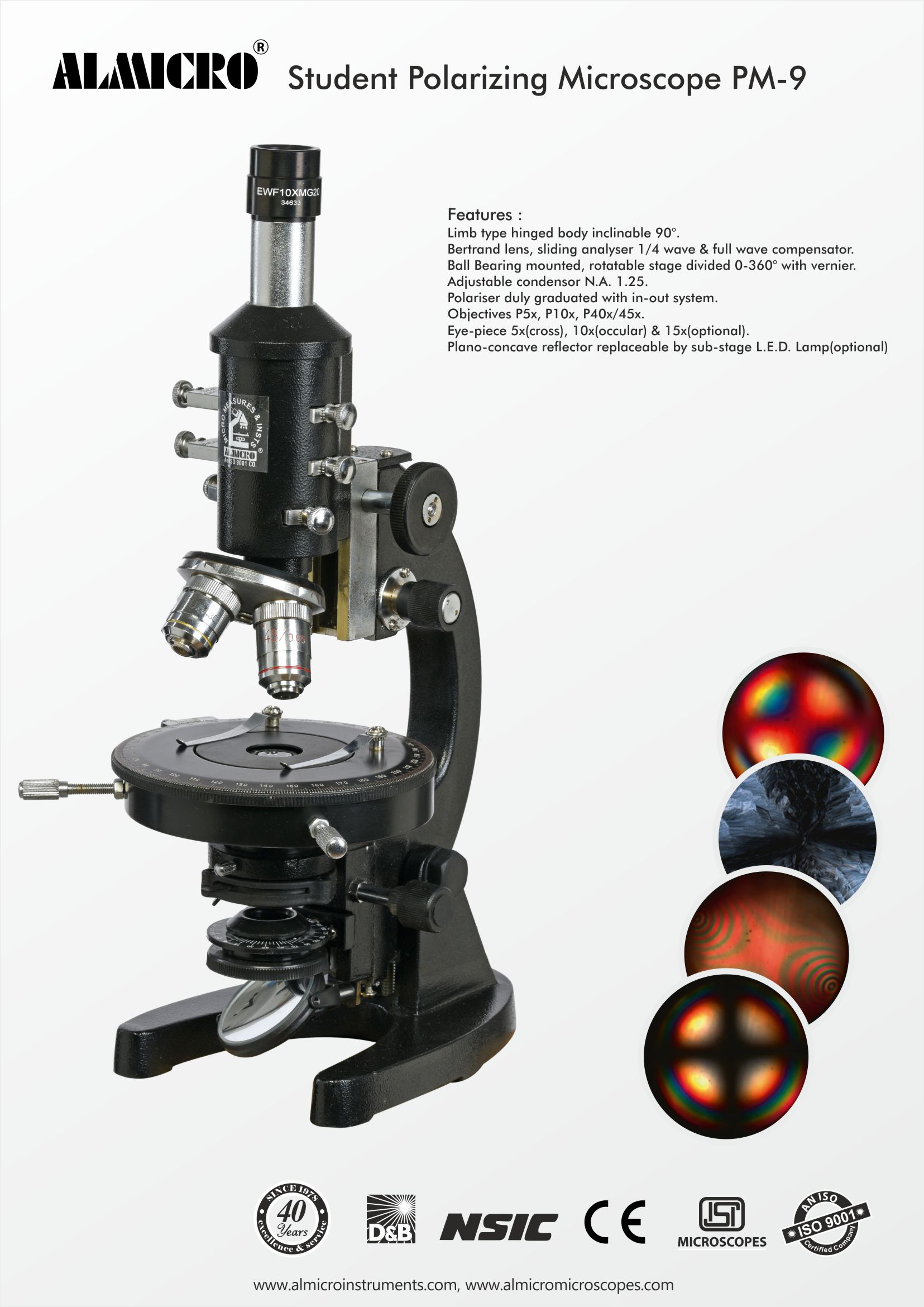
Description
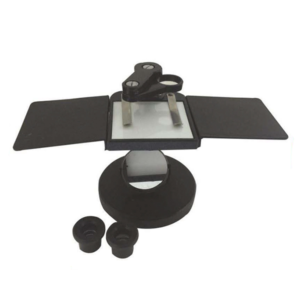
Technical Specifications – PM-9 Polarizing Microscope
| Specification | Details |
|---|---|
| Model | PM-9 |
| Microscope Type | Student Polarizing Microscope |
| Body Design | Limb-type, inclined body |
| Head Inclination | 90° inclined observation |
| Analyzer | Sliding analyzer |
| Compensators | 1/4 wave & full wave plate |
| Stage | Rotatable circular stage (0–360°) with vernier |
| Stage Movement | Ball-bearing mounted for smooth rotation |
| Condenser | Adjustable condenser, N.A. 1.25 |
| Polarizer | Fully graduated polarizer |
| Observation System | Binocular observation |
| Objectives | P5X, P10X, P40X, P45X |
| Eyepieces | 10X (standard), 15X (optional), cross eyepiece |
| Illumination | Plano-concave reflector / sub-stage LED (optional) |
| Packaging | Inner thermocol or styrofoam with outer cardboard box |
Key Features of Student Polarizing Microscope PM-9
-
Designed specifically for student and academic use
-
High-quality polarizing optical system for crystal and mineral study
-
360-degree rotatable stage with precise angular graduation
-
Smooth ball-bearing mounted stage for accurate specimen alignment
-
Equipped with sliding analyzer for polarized light observation
-
Includes ¼ wave and full wave compensators for advanced analysis
-
Adjustable N.A. 1.25 condenser for improved contrast and clarity
-
Multiple polarizing objectives for detailed magnification
-
Comfortable inclined viewing design for long working hours
-
Optional LED sub-stage illumination for uniform brightness
-
Strong mechanical construction for long-term laboratory use
Working Principle of Polarizing Microscope
The Student Polarizing Microscope works on the principle of polarized light interaction with anisotropic materials. Light from the source first passes through the polarizer, producing plane-polarized light. When this light interacts with birefringent specimens such as crystals or minerals, it splits into two rays with different velocities. These rays recombine through the analyzer, producing characteristic interference colors and patterns. By rotating the stage and using compensators, users can analyze optical properties like extinction angles, birefringence, and crystal orientation accurately.
Applications & Use Areas
-
Educational institutions for teaching mineralogy and crystallography
-
Geology laboratories for mineral identification
-
Material science labs for polymer and fiber analysis
-
Physics and chemistry labs for optical studies
-
Research institutes for polarized light experiments
-
Training labs for microscopy fundamentals
Why Choose Almicro PM-9 Polarizing Microscope?
-
Trusted Almicro quality (since 1978)
-
Ideal balance of performance and affordability
-
Designed for students, teachers, and lab professionals
-
Accurate polarizing accessories for practical learning
-
Durable build with safe and secure packaging
Reviews
There are no reviews yet.