
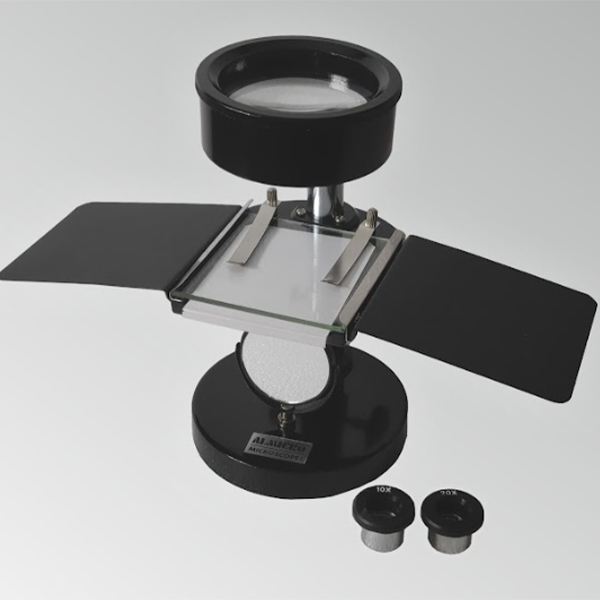

Description
Technical Specifications – Student Dissecting Microscope MD-2
| Specification | Details |
|---|---|
| Base | Heavy round base for stability |
| Body Design | Precisely engineered microscope body |
| Eyepieces | 10X and 20X eyepieces |
| Additional Lens | Special bull’s eye lens (83 mm dia.) |
| Viewing Arm | Joint revolving arm for full-stage coverage |
| Illumination | Plano-concave mirror for daylight and artificial light |
| Focusing | Rack-and-pinion focusing mechanism |
| Hand Rests | Detachable hand rests on both sides |
| Use Case | Student training, demonstration, organism study, basic dissection |
Key Features
-
Heavy round base for stability during observation
-
Rack-and-pinion focusing for smooth and sensitive adjustments
-
Joint revolving arm for scanning the entire stage area
-
Supports both standard magnifying eyepieces and a special bull’s eye lens
-
Bull’s eye lens (83 mm dia.) increases the field of vision
-
Plano-concave mirror for bright daylight and artificial light reflection
-
Detachable hand rests for steady dissection support
-
Supplied with 10X and 20X eyepieces for flexible magnification
-
Durable construction suitable for frequent student use
-
Ideal for demonstration, specimen observation, and basic dissection tasks
Working Principle
The Student Dissecting Microscope MD-2 works on the principle of reflected light magnification. Light is directed onto the specimen through a plano-concave mirror, which reflects both natural and artificial light. The illuminated surface creates a clear image when viewed through the low-power eyepieces.
The rack-and-pinion system allows controlled movement of the optical assembly, helping the user to achieve sharp focus.
The joint revolving arm enables the magnifying lens to move across the entire stage area, ensuring full specimen coverage without repositioning. The optional bull’s eye lens increases the viewing area, making it easier for students to study larger structures or broader surfaces.
Overall, the MD-2 provides a simple, stable, and reliable method for understanding the external features of small organisms and biological samples.
Use Cases
-
Biology practical training in schools and colleges
-
Basic dissection exercises
-
Surface study of insects, larvae, plant structures, and small specimens
-
Classroom demonstrations and teacher-led practical lessons
-
Initial-stage biological observation and learning

Reviews
There are no reviews yet.