
Description
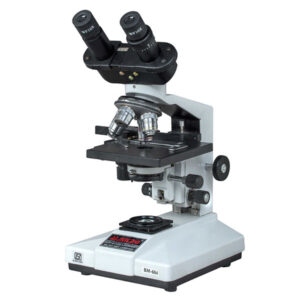
Technical Specifications – Compound Student Microscope (BM-3)
| Specification | Details |
|---|---|
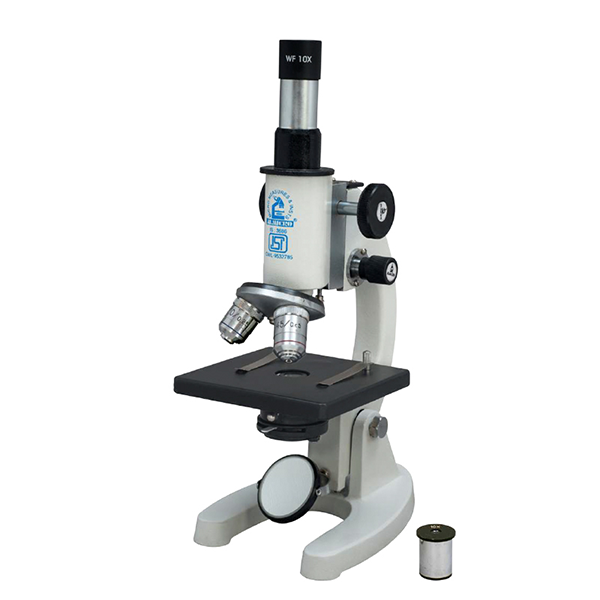
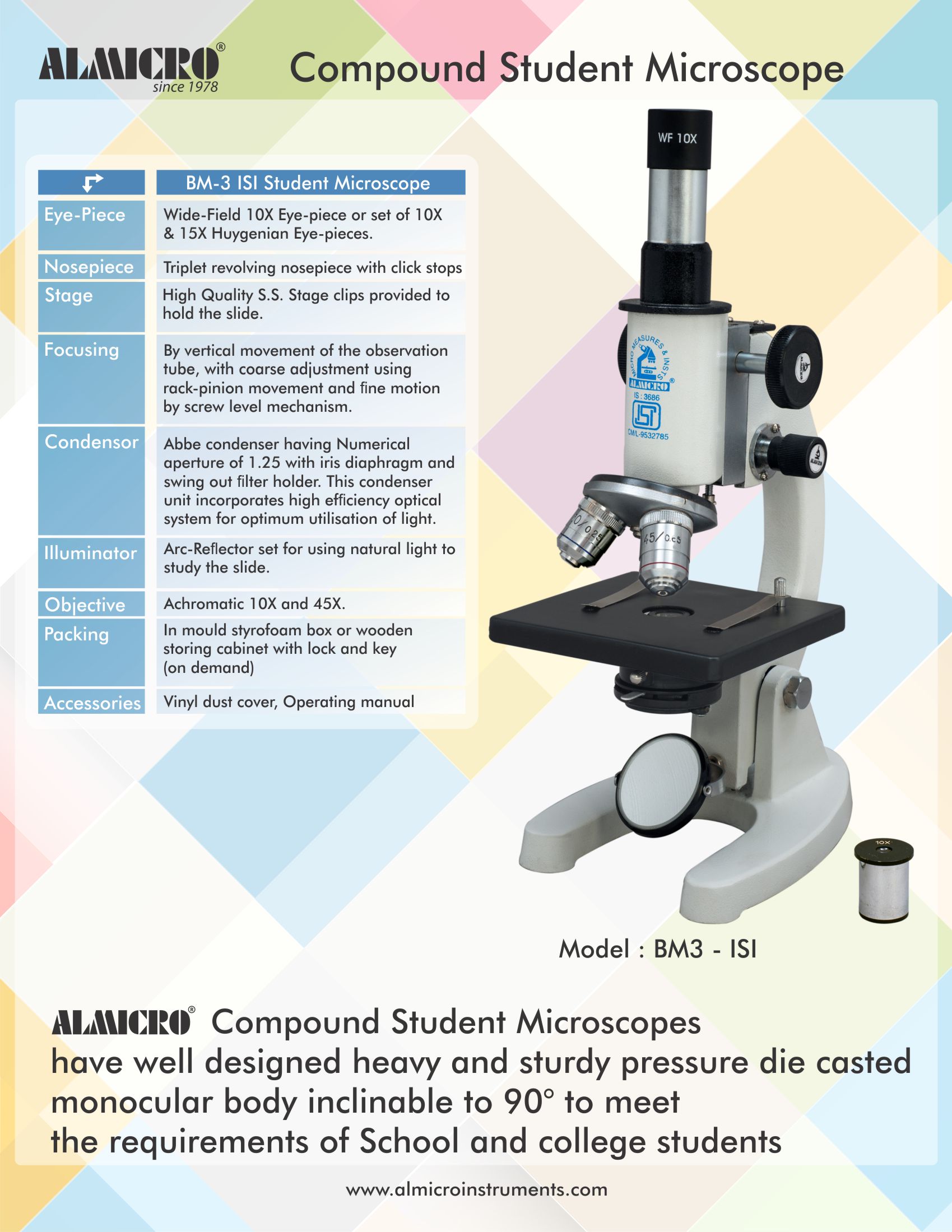
| Eyepieces | Wide-field 10X or set of 10X & 15X Huygenian eyepieces |
| Objectives | Achromatic 10X and 45X |
| Nosepiece | Triple revolving nosepiece with click stops |
| Stage | High-quality SS stage clips |
| Focusing | Coarse focus (rack-and-pinion) and fine focus (screw lever) |
| Condenser | Abbe condenser NA 1.25 with iris diaphragm and swing-out filter holder |
| Illuminator | Arc reflector for natural light |
| Compliance | ISI Marked, IS: 3686:1966 |
| Packing | Styrofoam box or wooden cabinet (on demand) |
| Accessories | Vinyl dust cover, operating manual |
| Use Case | Student learning, biology practicals, slide examination |
Key Features
-
ISI-standard model designed as per IS: 3686:1966
-
Wide-field 10X eyepiece or 10X & 15X Huygenian eyepiece set
-
Triple revolving nosepiece with click stops
-
Achromatic 10X and 45X objectives for clear and accurate imaging
-
Coarse and fine focusing mechanisms for precise adjustments
-
Abbe condenser (NA 1.25) with iris diaphragm and swing-out filter holder
-
High-efficiency optical system for bright, uniform illumination
-
Arc reflector for natural light-based slide study
-
Strong stage with stainless steel clips for secure slide placement
-
Option of styrofoam box or wooden storage cabinet with lock
-
Supplied with vinyl dust cover and operating manual
Working Principle
The BM-3 works using the transmitted light microscopy principle. Light from the arc reflector passes through the Abbe condenser, which concentrates and directs the illumination onto the specimen.
The condenser’s iris diaphragm allows the user to control light intensity, ensuring optimal contrast for different slide types.
The light then passes through the objective lens, where the primary magnification occurs. Achromatic objectives reduce color fringing, delivering clear and accurate images.
The magnified image travels through the eyepiece for final enlargement, giving students a sharp and detailed view.
The coarse and fine focusing systems help adjust the observation tube vertically. The rack-and-pinion mechanism supports broad adjustments, while the fine motion screw enables delicate, precise focusing.
This system ensures stable, bright, and accurate slide observation during classroom use.
Use Cases
-
School and college biology laboratories
-
Practical training for cell and tissue observation
-
Study of microorganisms, plant cells, and prepared slides
-
Basic biological research and student projects
-
Demonstration work by educators
Reviews
There are no reviews yet.